A brief catechism on eucharistic adoration (part 1)
 A Brief Catechism on Eucharistic Adoration (including website resources).
By Chris DiTomo
1. What should children and young people be taught about Jesus’ presence among us—in other words, where IS Jesus now… today?
Of course we need to teach our children that God is present everywhere (Psalm 139:1-12)… and therefore that we can invoke God’s presence in prayer at any time whether we are with our brothers and sisters in Christ (Matthew 18:20; 1 Corinthians 12:12-13), in a church, in the privacy of our room (Matthew 6:6), or in the beauty of nature (Psalm 97:6; Daniel 3:29-68). God is also present in His Word—the Holy Scriptures.
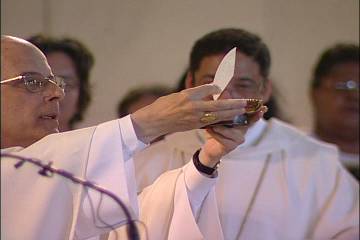
However, we must also teach them that we meet the Holy Trinity in a special way through the sacraments—and most especially in the Holy Eucharist. During the Mass, the priest extends his hands and calls down the Holy Spirit to transform the gifts of bread and wine into the Body and Blood of the Son of God Jesus, re-presenting that one offering of sacrifice to the Father that happened at Calvary nearly 2,000 years ago!
Of course, Jesus Christ is substantially present during the Holy Mass. As the priest—acting in the person of Jesus Christ—speaks the words of consecrations (“This is my body… this is my blood…”) the bread and wine are transformed into the most precious Body and Blood, Soul and Divinity of Jesus Christ. The technical term for this great wonder is “transubstantiation.” This is a complex philosophical term that simply states that while the outward appearance and qualities of the bread and wine remain (for example, the appearance, color, shape, smell, taste of the bread and wine, including the chemical properties of the alcohol, etc.) the inward SUBSTANCE (what the thing most truly is in its essence or nature) has changed into the Body and Blood of Jesus. So that when we receive what seems like mere bread and wine during Holy Communion at Mass—we are actually taking into our bodies God himself—the Creator of the world—Jesus Christ the Redeemer of the world—crucified, risen, glorified, ascended into Heaven—the undivided Holy Trinity: Father, Son, and Holy Spirit. Too amazing for words!!!
But, the wonder does not end there! Jesus remains present in the consecrated “species” (the transformed bread and wine). We reserve the Holy Eucharist, or “the Blessed Sacrament”, in the form of the hosts in a beautifully crafted and adorned cabinet called the tabernacle. Before the time of Jesus, the Israelites kept the signs of God’s presence—the 10 Commandment tablets, the “manna” bread that came down from heaven to miraculously feed them while in the desert, and the staff of the high priest Aaron—in a beautifully constructed box called the Ark of the Covenant (see Exodus 25-27, etc.). The Ark was kept in a tent (“tabernacle”) and carried by the Israelites wherever they went as the most sacred resting place of God’s presence among His people (they even took it with them into battle!). Eventually, King Solomon built a temple to house the Ark.
You might want to point out the tabernacle in the Church to the children. You should remind the children that they should always genuflect and can make the sign of the cross while entering a church or when passing in front of the tabernacle. This is a sign of respect for Jesus’ presence. The tabernacle can always be identified by the red sanctuary candle which is always kept burning night and day as a symbol of Jesus’ abiding presence (Scripture also recounts how God showed his presence to the Israelites in the form of a column of fire as He led them out during the Exodus from slavery in Egypt (Exodus 14:24, etc.).
Therefore, while we can pray to God anywhere… we can pray to God and sit in the presence of Jesus in a special way when we spend time in front of the Blessed Sacrament reserved in the tabernacle of any Catholic Church.
When we want to pray before Jesus in the Blessed Sacrament in an even more special way, a priest places a sacred Host in what is called a monstrance. [Word comes from a Latin term. Think of the word “de-monstrate” meaning to display or show.] We have monstrances in display cases both at St. Patrick and St. Joseph’s churches. We have regular “holy hours” of Eucharistic adoration at St. Patrick’s (every Friday from 11 until noon) and at St. Joseph’s and St. Michael’s during the first week of the month.
The Blessed Sacrament is placed in a little glass window so that people can gaze directly upon Jesus as they adore Him. The monstrance is another precious vessel made of gold that is often in the shape of a sun with rays extending out. Before the time of Jesus pagans used to worship the sun (some pagans still do this today). Now we recognize that Jesus is the only God—he is the Son of God and also the “Sun” of God because just as the sun returns each day—overcoming the dark night by rising in the East, Jesus Christ our Lord and messiah will one day return at the end of the world (Daniel 7:13-14; Mark 14:61-64). He will then completely be “the light of the World” (John 1:9; 8:1), so that we can truly be the “children of light” that we are called to be (Ephesians 5:8). Eucharistic adoration, like the Mass, is a foretaste of the Heavenly Jerusalem, where “the city has no need of sun or moon to shine upon it, for the glory of God is its light, and its lamp is the Lamb” (Revelation 21:23). When we look upon our Lord, we are practicing for our life in Heaven: “Blessed are the pure in heart, for they shall see God” (Matthew 5:8). J
2. How else can we describe the ways that Jesus is present?
“[Children and young people] are to be taught and trained to realize that Jesus Christ is indeed at the right hand of His heavenly Father. But Jesus Christ is also:
physically
geographically
really
completely now on earth, present in the Blessed Sacrament, offering Himself in the Sacrifice of the Mass and received by us-His Body in our bodies in Holy Communion.” --Fr. John Hardon, S.J., 2000 address The Greatest Need in the World Today—Forming the Eucharistic Faith and Love of Children, full text available on http://www.therealpresence.org/ .
2. How else can we describe the ways that Jesus is present?
“[Children and young people] are to be taught and trained to realize that Jesus Christ is indeed at the right hand of His heavenly Father. But Jesus Christ is also:
physically
geographically
really
completely now on earth, present in the Blessed Sacrament, offering Himself in the Sacrifice of the Mass and received by us-His Body in our bodies in Holy Communion.” --Fr. John Hardon, S.J., 2000 address The Greatest Need in the World Today—Forming the Eucharistic Faith and Love of Children, full text available on http://www.therealpresence.org/ .
3. How can Jesus be present in the tabernacle at St. Patrick’s and, at the same time, present in the tabernacles of other churches throughout the world?
This is the power of the sacraments. God is not bound by space and time like we are. He can be in many places at once—in deed, God is present anywhere. Jesus instituted the sacraments so that his priests could make him present in this mysterious way to people all over the world at all times.
4. What if it feels weird to kneel in front of a tabernacle or monstrance… it feels like I am worshipping bread?
That might be a natural human reaction. However, just think what you would do if you saw Jesus walking by you… or if Jesus was present in a room? I know that I would sure get on my knees and adore him! That is exactly what people did in the Bible. Now we have to remember, that what looks like bread is no longer truly bread—but is the Body, Blood, Soul, and Divnity of Jesus Christ. God Himself is present on that altar during Mass and in that tabernacle or monstrance after Mass. So, we should adore God just like we hope to do for all eternity in heaven. You can also think about what we do at the Mass. Remember that we kneel down as the priest holds us the transformed host—the lamb of God broken for our sins—and says, “Behold the Lamb of God who takes away the sins of the world…” At that very moment, we are doing “Eucharistic adoration.” When we kneel before the tabernacle or the monstrance, we are simply extending this wonderful moment for a longer time period.
Labels: Eucharist, spirituality, vocations
posted by CPDT @ 12:43 PM