Tuesday, January 01, 2008

Catechesis on Mary, the Mother of God


This post comes from the Rosary Army webste (http://www.rosaryarmy.com/), a site that has some interesting catechetical postings.

http://www.rosaryarmy.com/2007/12/saturday
-morning-catechesis-mother-of.aspx


Saturday, December 29, 2007

Saturday Morning Catechesis: Mother of God


Posted by Mickey Addison @ 12:00 AM

On New Year's Day, the Church celebrates the Solemnity of Mary, Mother of God. As with all Marian pieties and dogmas, it is a celebration that points to something about Christ.

Non-Catholics sometimes have the most difficult time with the Marian dogmas, perhaps because they take them at face-value without looking at why these dogmas are part of Sacred Tradition in the first place. I have a friend, for example, who has no issues with the Real Presence of Christ in the Eucharist, but struggles mightily with Marian dogmas.

In a sense, acceptance of Marian dogmas makes belief in the Real Presence easier.

Our Blessed Lady has been addressed by the title, "Mother of God" since at least A.D. 407. St John Chrysostom wrote a Eucharistic Prayer that included the title of Mother of God, presumably in congruence with the popular piety of the time. This title was not without controversy, however, even in the 5th century.

The Nestorian Heresy, led by a man named Nestorius, Bishop of Constantinople (A.D. 428-431) postulated that Our Lady only gave birth to Jesus' human nature, and therefore deserved only the title, "Mother of Jesus." Nestorius theorized that Jesus was "inhabited" by the Divine Word; essentially that the person of Jesus Christ was a sort of "possessed" body where the Word dwelt inside Jesus "as a temple."

Of course, this theory leads to all sorts of heretical ideas, not the least of which is that Jesus Christ was two people and that the flesh He sacrificed was not sanctified or elevated by union with the divine.

The Nestorian heresy was refuted initially by St. Cyril, Bishop of Alexandria (d. 440), "It was not that an ordinary man was born first of the Holy Virgin, on whom afterwards the Word descended; what we say is that, being united with the flesh from the womb, (the Word) has undergone birth in the flesh, making the birth in the flesh His own..."

At the Council of Ephesus in A.D. 431 finally settled the matter, declaring: "If anyone does not confess that the Emmanuel is truly God and therefore that the holy Virgin is the Mother of God (Theotokos) (since she begot according to the flesh the Word of God made flesh), let them be anathema [despised]."

The Council declared once and for all that Jesus Christ is Lord, the Divine Second Person of the Trinity, true God and true Man united together. The Blessed Virgin gave birth to a single Person with two natures...not two persons with two natures. As the Catechism succinctly teaches, 'Mary is truly "Mother of God" since she is the mother of the eternal Son of God made man, who is God himself.' (#509)

The first day of the New Year is a splendid opportunity to reflect on the marvel of the Word Made Flesh, and the woman He took His flesh from when He came among us.
_______________________________________________
Mickey Addison is a career military officer, and has been a parish level catechist and Catholic Scripture Study, Int'l leader.
He and his wife have two children. He can be contacted at addisoncrew@gmail.com.

Labels: , , , ,

Thursday, December 07, 2006

Feast of the Immaculate Conception: Honoring Mary, the New Eve and Mother of the Redeemer!

This evening we celebrate the Feast of the Immaculate Conception.

From the new Compendium of the Catechism of the Catholic Church:

96. What does the “Immaculate Conception” mean?

God freely chose Mary from all eternity to be the Mother of his Son. In order to carry out her mission she herself was conceived immaculate. This means that, thanks to the grace of God and in anticipation of the merits of Jesus Christ, Mary was preserved from original sin from the first instant of her conception.

“God freely chose Mary from all eternity to be the Mother of his Son”: Did you ever think that maybe Mary was just randomly selected at a young age to be the mother of the Incarnate Son of God? Not likely. Just like us, God the Father chose Mary “before the foundation of the world, to be holy and blameless before him in love” (Ephesians 1:3-4). God had predestined all of us for some role in his plan of salvation. He knew us before we were created (Ps 139). If God also would have chosen a woman to freely say “yes” to his plan of salvation… don’t you think that He would have put a great deal of thought into how this woman would be created? How beautiful would you create a woman who was to be “the mother of the Savior”?

“In order to carry out her mission she herself was conceived immaculate”: Mary’s mission was to be the one who would say “yes” to God’s plan of salvation. Remember, God never forces his love upon the creatures that he made free. I once heard it put rather bluntly—God would not “rape” humanity. He would not force the incarnation against our will. He desired our free assent. It was in the disobedience of Eve (which led to the disobedience of Adam) that led to the first Fall. In order to redeem the human race, God posed the question of his Incarnation to a New Eve...a new representaive for the entire human race.

It is because Mary said “yes” (her “fiat”—"let it be done to me according to your word") that Jesus, the Incarnate Son of God (and “the New Adam” see Romans 5:12-21), entered the world, and eventually redeemed the human race by his obedience to the Father on the Cross (reversing the disobedience of Adam).

Once again, in order to be most free to say yes or no, God created Mary free from the stain of Original Sin. Without such a burden she was completely free in her will to obey God… she was not a slave to concupiscence (the tendency that we all have towards sin—even after baptism).

“thanks to the grace of God and in anticipation of the merits of Jesus Christ": If Mary was created free from the stain of Original Sin does that mean that she still needed a savior? Yes, without a doubt! The Immaculate Conception was a unique and extraordinary GRACE from God… a gift to Mary. And, it was given “in anticipation of the merits of Jesus Christ.” This is tricky for us to contemplate, but remember that God is eternal—outside of time. There is no past, present, or future with God. He sees everything as an eternal now. God could apply graces won by Jesus on the Cross to Mary at the time of her conception (before the sacrifice on the cross occurred in history). He is God—He is not limited by categories of time as we are.

Scriptural evidence

The Scriptures that are mentioned most in relation to this dogma of the Immaculate Conception are Luke 1:28 where Mary is addressed by a name (which expresses a characteristic quality, an identity) as “full of grace” (Greek: kecharitomene). [this is a better translation than what you find in the New American Bible, for example, “favored one”]. In addition, the Church points back to the proto-evangelium (first announcement of the Gospel) in Genesis 3:15: “I will put enmity between you and the woman, and between your offspring and hers; He will strike at your head, while you strike at his heel.’ This is directed to the devil and Eve. However, it also points forward to the woman who whose offspring (Jesus) would do battle with the devil and his offspring. For this woman to be at total enmity (hatred) with the devil, she had to be completely free from the stain of Original sin.

The Bible also has other clues to the Immaculate Conception. The Ark of the Covenant also is a “type” that foreshadows and points ahead to Mary who is the "New Ark of the Covenant" (compare Luke 1:26-44 with Exodus 40:34-35 and 2 Sam 6:9-16). The Ark of the Covenant was the holiest object in the Old Testament. It was beautiful box created of precious materials… it was to be spotless in construction. [See Exodus 25 where God gave meticulous instructions for constructing the Ark: it was to be made of acacia wood—supposedly incorruptible—plated inside and outside with pure gold, it had to be kept free from all impurity and profanation. In 2 Samuel 6:6-7 God struck Uzzah dead because he dared to touch the Ark!.]

The Ark held the tablets of the 10 Commandments (the Word of God), the manna (bread from heaven) that fed the Israelites in the desert, and Aaron’s staff. Mary was the spotless carrier of Jesus—the Word of God Incarnate, and the Bread of Life (John 6). If such care was taken in the creation of a pure and perfect Ark of the Covenant, how would Mary the Mother of God be created? How pure would God create the woman who would bear the Divine Redeemer?

Do not forget to be familiar with the dogma of the Assumption of Mary:
http://swallowedscroll.blogspot.com/2006/08/maria-assumpta-est-
mary-is-assumed_14.html


What did the ancient Church fathers teach about Mary's holiness?:
http://www.cin.org/users/jgallegos/immac.htm and
http://www.cin.org/users/jgallegos/theotok.htm

More notes on how to explain and defend belief in the Immaculate Conception:
http://www.catholic.com/library/Immaculate_
Conception_and_Assum.asp


St. Anselm on the Immaculate Conception:
http://www.crossroadsinitiative.com/library_article/108/Virgin_Mary
__Mother_of_the_Re_created_World____St._Anselm.html

Labels: , ,

Saturday, October 14, 2006

The Idiot's Guide to Prayer - Part I: The Jesus Prayer


This is the first of a series on Christian prayer. Do not be offended by the title of the series--we are ALL idiots when it comes to prayer. Indeed, legendary prayer warrior St. Paul, himself stated, "the Spirit helps us in our weakness; for we do not know how to pray as we ought, but the Spirit himself intercedes for us with sighs too deep for words" (Rom 8:26).

But, prayer is actually simple. We speak to God, and then we listen. But what are some practical ways to start this daily conversation? Let's start with one of the simplest ways:

"The Jesus Prayer"

"Lord Jesus Christ, Son of God, have mercy on me, a sinner!"
Catechism of the Catholic Church #2616

This is a prayer that has been highly treasured among Eastern Orthodox and Eastern-rite Catholics throughout history. Let's take a look at it piece-by-piece:

Many times we wonder, "I don't know how to pray... where do I start... how do I focus my mind when it is racing a mile a minute with distractions?... how do I make myself present to God and God to me?"

"Lord Jesus Christ..."
This sounds deceptively simple. Did you realize that when you utter these 3 words something incredible happens? Scripture tells us that "no one can say 'Jesus is Lord' except by the Holy Spirit" (1 Corinthians 12:3). If you begin your prayer of adoration by uttering the holy name of Jesus, and make an act of faith that he is "Lord" of heaven and earth, of your marriage and family, of your entire life... then the Holy Spirit is without a doubt at work within you. Whether you are inside a church or not, God is present within and among you (even if you "feel" that God is far away from you). 3 little words can reassure you that God is with you. St. Paul also writes of the holy name of Jesus that "at the name of Jesus every knee should bow, in heaven and on earth and under the earth, and every tongue confess that Jesus Christ is Lord, to the glory of the Father" (Phil 2:10).

"Son of God..."
Scripture tells us that "when anyone acknowledges that Jesus is the son of God, God dwells in him and he in God" (1 Jn 4:14-15). Think also of St. Peter's confession of faith. When Jesus asked his disciples who people said that he was, and who they thought he was, Peter stepped up and made the confession heard 'round the world: "You are the Christ, the Son of the living God" (Mt 16:16). How did Jesus respond to this? "Blessed are you Simon, Bar-Jona! for flesh and blood has not revealed this to you, but my Father who is in heaven" (Mt 16:17). In other words, Peter was not able to make this confession of faith because of his own human brilliance or intuition. Nor did another man tell him about Jesus' true identity. "Flesh and blood" did not reveal this divine truth to Peter. The only way that Peter could have made this confession was because the "Father who is in heaven" gave him a special revelation. When you pray the Jesus prayer in faith--the grace of God is at work within you to know the true identity of Christ. So, God is present in heaven ("Our Father, who art in heaven...") AND also He is present in our midst in an intimate way.

"Have mercy on me, a sinner."
How else do we present ourselves before God in prayer than through contrition and humility. Part of prayer is acknowledging reality. The truth is that God is God--the creator of the heavens and the earth. ... and that we are NOT God. We are God's creation... we are creatures. God does not "owe" us anything... but He does desire to give us everything as a grace. We are children dependent upon our loving Father for everything. To receive his gifts, of course, one thing is required: we must be humble enough to accept them. God will never force himself on anyone. We must never approach God as the self-righteous Pharisee in the Temple, but rather as sinners in need of mercy (like the tax collector--"God , be merciful to me, a sinner!" Lk 18:13). We must admit that are like Bartimeus the blind beggar and cry out, "Son of David, have mercy on me!" (Mk 10:48; see also Mt 9:27).

When you sit down to pray, and you want to offer up all of your thanksgiving and joy... when you want to let go of all distractions,... all confusions,... all anger... all darkness and the feelings of God's absence (prayer is not chiefly about "feelings")... then begin by slowly repeating this prayer. Then take comfort... for whether you "feel" it or not... God is present... in your midst.


Thoughts?... Comments?... leave a comment by clicking below...

Labels: , ,

Monday, August 14, 2006

Maria Assumpta Est! (Mary is Assumed!)


Tomorrow (August 15) is the feast of the Assumption of the Blessed Virgin Mary into Heaven.
A great way to celebrate this wonderful feast day (besides attending Mass—this is a Holy Day of obligation, remember) is to take a little time to study the Church's teaching on the dogma of the Assumption.
OK, here is a test for how well you know your faith. Can you explain what this doctrine is?

Let's go to the Catechism of the Catholic Church for help:


966. “Finally the Immaculate Virgin, preserved free from all stain of original sin, when the course of her earthly life was finished, was taken up body and soul into heavenly glory, and exalted by the Lord as the Queen over all things, so that she might be the more fully conformed to her Son, the Lord of lords and conqueror of sin and death” [Lumen Gentium 59, Pius XII Munificentissimus Deus (1950)]. The Assumption of the Blessed Virgin is a singular participation in her Son's Resurrection and an anticipation of the resurrection of other Christians.

Did you get all that? OK, let's analyze this piece by piece.

1.“the Immaculate Virgin, preserved free from all stain of original sin”:

This, of course, is the central Marian dogma—the Dogma of the Immaculate Conception. By a unique and singular grace of God, Mary was kept from the stain of Original Sin... This was a GIFT from God: it was the result of the grace of God... the grace that would come as result of Jesus Christ's passion, death, and resurrection.
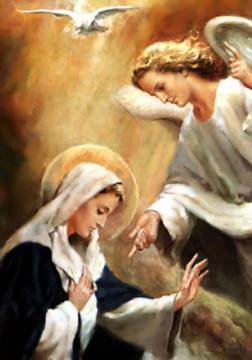
You might ask, how could God give grace to Mary BEFORE Jesus won that grace for her on the Cross in Cavlary. Remember, God is eternal... God is not bound by time, He is outside of time. God has the power to apply to any man or woman the grace that will result from a future event. At any rate, Mary was conceived free from all stain of original Sin (just as Adam and Eve were), SO THAT she could be COMPLETELY FREE to say YES or NO at the Annunciation. If Mary was burdened with Original Sin, she would have been (like the rest of us), slaves to sin, slaves inclined to doing our own will rather than the will of God.

2. “When the course of her earthly life was finished”:

The dogma as stated does not say definitively whether or not Mary died, and then was assumed body and soul to heaven... or whether she was just taken up without having to actually undergo death. This is a matter of theological speculation, people are free to entertain their own theories because it not defined as part of the dogma. Note also that Jesus “ascended” (went up) into heaven by his own power—as God. Mary, was “assumed”... drawn up to heaven by the power of God... not by her own power. Although she is the most perfect of creatures--the Immaculate, Mary is still a creature, after all. Do not get that aspect of the “assumption” and the “ascension” confused as some do. Remember also, that the Bible speaks of two previous “assumptions” into heaven: Enoch (Gen 5:24) and Elijah (the fiery chariot—2 Kings 2:11).

3. “so that she might be the more fully conformed to her Son, the Lord of lords and conqueror of sin and death” ...
4. “a singular participation in her Son's Resurrection and an anticipation of the resurrection of other Christians.”


What happened to Mary is unique (a singular gift). She is the only one who is PERFECTLY in God's presence (not just her soul, but she is complete as a person—soul AND glorified body, living in communion with the Holy Trinity in heaven). The other saints are in God's presence in heaven, but the consummation/perfection of their heavenly life will come at the end of time—with the Resurrection of the dead, when everyone has their bodies restored to them. Jesus loved His mother so much, and they were so close, that he gave Mary an “advance payment” you can say... she is enjoying the full fruits of His victory over death now. We are all destined to be conformed to Jesus Christ—that has already begun with our baptism, and it is nourished every time we receive the sacraments. But, Mary is already fully conformed to Jesus. So, this dogma of the Assumption teaches us about Mary's existence body and soul into heaven so that we can look to her as a sign of our future hope. What she is now, glorified in heaven, in the presence of God—Father, Son, and Holy Spirit—we one day can hope to be! Praise God!

The newly published Compendium of the Catechism of the Catholic Church states this last point nicely:

199. In what way is the Blessed Virgin Mary the eschatological icon of the Church?
Looking upon Mary, who is completely holy and already glorified in body and soul, the Church contemplates in her what she herself is called to be on earth and what she will be in the homeland of heaven.

[“eschatological” is a theological term that refers to the phenomena associated with the end of time, what we traditionally refer to as the 4 “last things”--Death, Judgment, Heaven, Hell. “eschata” is Greek for “last things”]

WAIT, YOU ARE NOT DONE YET....

Check out this article on the Assumption:
http://www.crossroadsinitiative.com/library
_article/190/Assumption_of_the_
Blessed_Virgin_Mary.html


Understand and Explain the Assumption to your non-Catholic Christian friends:
http://www.catholic.com/library/
Immaculate_Conception_and_Assum.asp


You can listen to an MP file of a radio program on the Assumption (Catholic Answers Live):
Go to August 15 on the callendar, "Maria Assumpta Est"
http://www.catholic.com/radio/calendar.php


Here is a homily by doctor of the Church St. John Damascene (d. 749)

This reading on the Assumption of Mary is taken from the first homily of St. John Damascene on the Assumption of the Blessed Virgin Mary.

“But even though, according to nature, your most holy and happy soul is separated from your most blessed and stainless body and the body as usual is delivered to the tomb, it will not remain in the power of death and is not subject to decay. For just as her virginity remained inviolate while giving birth, when she departed her body was preserved from destruction and only taken to a better and more divine tabernacle, which is not subject to any death . . . Hence I will call her holy passing not death, but falling asleep or departure, or better still, arrival. . . .

"Your stainless and wholly immaculate body has not been left on earth; the Queen, the Mistress, the Mother of God who has truly given birth to God has been translated to the royal palaces of heaven. .

"Angels and archangels have borne you upwards, the impure spirits of the air have trembled at your ascension. The air is purified, the ether sanctified by your passing through them. . . the powers meet you with sacred hymns and much solemnity, saying something like this: Who is she that comes forth as the morning rising, fair as the moon, elect like the sun? [cf. Cant 6:9] How you have blossomed forth, how sweet you have become! You are the flower of the field, a lily among the thorns [Cant 2.1] . . . Not like Elijah have you entered heaven, not like Paul have you been rapt to the third heaven; no, you have penetrated even to the royal throne of your Son himself . . . a blessing for the world, a sanctification of the universe, refreshment for those who are tired, comfort for the sorrowing, healing for the sick, a port for those in danger, pardon for sinners, soothing balm for the oppressed, quick help for all who pray to you. . .

“Good Mistress, graciously look down on us; direct and guide our destinies wheresoever you will. Pacify the storm of our wicked passions, guide us into the quiet port of the divine will and grant us the blessedness to come.”

Labels: , , , ,