Friday, May 30, 2008

St. Augustine on the House Built on Rock


Commentary on this week's Gospel: 9th Sunday in Ordinary Time

Matthew 7:21-27

The House Built on Rock, The House Built on Sand


From St. Augustine's exposition of the Sermon on the Mount:


87. Hence we must take special notice how terribly the conclusion of the whole sermon is introduced: “Therefore, whosoever heareth these sayings of Mine, and doeth them, is like 242 unto a wise man, which built his house upon the rock.” For no one confirms what he hears or understands, unless by doing. And if Christ is the rock, as many Scripture testimonies proclaim 243 that man builds in Christ who does what he hears from Him. “The rain descended, and the floods came, and the winds blew, and beat 244 upon that house; and it fell not: for it was founded upon a rock.” Such an one, therefore, is not afraid of any gloomy superstitions (for what else is understood by rain, when it is put in the sense of anything bad?), or of turnouts of men, which I think are compared to winds; or of the river of this life, as it were flowing over the earth in carnal lusts. For it is the man who is seduced by the prosperity that is broken down by the adversities arising from these three things; none of which is feared by him who has his house founder upon a rock, i.e. who not only hears, but also does, the Lord’s commands. And the man who hears and does them not is in dangerous proximity to all these, for he has no stable foundation; but by hearing and not doing, he builds a ruin. For He goes on to say: “And every one that heareth these sayings of Mine, and doeth them not, shall be like unto a foolish man, which built his house upon the sand: 245 and the rain descended, and the floods came, and the winds blew, and beat 246 upon that house; and it fell: and great was 247 the fall of it. And it came to pass, when Jesus hid ended these sayings, the people were astonished at His doctrine: for He taught them as one having authority, and not as their scribes.”248 This is what I said before was meant by the prophet in the Psalms, when he says: “I will act confidently in regard of him. The words of the Lord are pure words: as silver tried and proved in a furnace of earth, purified seven times.” 249 And from this number, I am admonished to trace back those precepts also to the seven sentences which He has placed in the beginning of this sermon, when He was speaking of those who are blessed; and to those seven operations of the Holy Spirit, which the prophet Isaiah mentions; 250 but whether the order before us, or some other, is to be considered in these, the things we have heard from the Lord are to be done, if we wish to build upon a rock.


242 Similis est… Vulgate, assimilabitur. Meyer, Tholuck, etc, refer this to the future judgment, “I will make him like,” etc., when Christ will establish those who keep His sayings for ever (opposed by Alford etc)..

243 (1Co 10,4, Alford, who thinks this signification too plain to overlooked.

244 Offenderunt; Vulgate, irruerunt.

245 The transitory teachings and institutions of men as opposed to Christ’s own word.

246 Offenderunt; Vulgate, irruerunt.

247 Facta est; Vulgate, fuit.

248 Vulgate adds et Pharisaei. The people were astonished, not merely at His teachings, but the dignity and self-consciousness with which Christ uttered them, quod nova quaedam majestas et insueta hominum mentes ad se raperet (Calvin). The Scribes spoke as expounders of the law, and referred back to Moses for their authority; Christ spoke in His own name, and as an independent legislator, vested with greater authority than Moses and a higher dignity. The Scribes by elaborate sophistry often drew many meanings from a single precept, and burdened the people with an intricate and endless variety of precepts for the details of conduct, laying painful stress upon their observance; Christ directed attention from outward acts to the motive and intent of the heart. “He opposed a genuine righteousness to the mock righteousness of the Scribes and Pharisees.”

249 (Ps 12,5-6.

250 (Is 11,2-3).

Labels: , ,

Tuesday, January 22, 2008

Spend 40 Days with the Fathers

I found this little nugget on www.churchyear.net . It is a Church Fathers Lenten reading plan (texts included). It is a long pdf document, but well worth printing out. This would provide a good introduction to the early Church fathers for the neophyte... and good sound spiritual reading for the ones who have read these before...

http://www.churchyear.net/lentfatherscomplete.pdf

Labels: , , ,

Tuesday, January 15, 2008

St. Cyril of Alexandria on spiritual warfare


I am currently reading St. Cyril of Alexandria's (376?-444) Commentary on the Gospel of Luke. His words on the parable of the sower and the seed (Lk 8:5-8)--especially as he treats of the seed that falls on rock (I thought this was apropriate given our most recent men's group discussion on spiritual warfare):

"And next, let us consider those others of whom Christ said, And those upon the rock are they who, when they hear, receive the word with joy, and they have no root; these for a while believe, and in time of temptation depart away. For there are verily [truly] men whose faith has not been proved, depending on words simply, and not applying their mind to the examining of the mysteries; of such the piety is sapless and without root. For when they enter the churches, they feel pleasure often in seeing so many assembled, and joyfully receive instruction in the mysteries from him whose business it is to teach, and laud him with praises; but this they do with no discretion or judgment, but with unpurified wills; and when have gone out of the churches, at once they forget the sacred doctrines, and proceed their customary course; not having stored up within them any thing for their future benefit. And if the affairs of Christians go on peacefully, and no trial disturb them, they even then scarcely maintain in them the faith, and that, so to speak, in a confused and tottering state. But if persecution trouble them, and the enemies of the truth attack the churches of the Savior, their heart loves not the battle, and their mind throws away the shield and flees being devoid of zeal, and destitute of love towards God, and ready for desertion. But O ye fearful and infirm, one may well say, why do ye flee from that which would be your glory? And escape from conflicts to which ye have been trained? For hereby those who wish may win for themselves the trophy of victory. Do ye also struggle; twine the chaplet of manliness, thirst for the rewards of perseverance, for the honors of patience.

"…Therefore, as the prophet Jeremiah has said, Take up arms and shields (Jer 46:3). Especially as the right hand of God our savior is invincible in battle, and as most wise Paul has said, He does not permit men to be tried more than they can bear, but with the trial will also come the way of egress [return], that they may be able to endure patiently. (1 Cor 10:13)

"…He [Christ] laid down his life for us, and with His blood purchased the world. We are, therefore, not our own, but His Who bought and redeemed us, and to whom we owe our lives. For as the divine Paul said, For this reason Christ died and lived, that He might be Lord of the dead and the living. (Rom 14:9) We ought, therefore, to possess a mind incapable of being shaken, that especially whenever temptation arrive, we may show ourselves approved and victorious in the power of patience; and ready with joy to undergo conflicts, and seize the opportunity of suffering for piety’s sake towards Christ."

More on St. Cyril, the "doctor of the Incarnation":

http://www.catholic.org/saints/saint.php?saint_id=616

Labels: , ,

Friday, January 04, 2008

Even St. Augustine has a MySpace!


I heard about this St. Augustine MySpace profile. I imagine that some Augustinian priest or brother created this? I am not sure whether your average MySpace user would actually read the meaty blog posts of his Confessions, but this is a neat idea. [PS: just finished listening to Confessions via audio book, it is a must read/hear]


Labels: , , , , ,

Thursday, January 03, 2008

Scripture notes from the Fathers on the Epiphany


This is just some notes for my parish Bible study today (based on my reading of Epiphany homilies from The Sunday Sermons of the Great Fathers: A Manual of Preaching, Spiritual Reading and Meditation.

Feast of Epiphany, Gospel reading: Mt 2:1-12

gifts

gold—as to a king (offered as tribute to a king); also symbolizes wisdom (Prov 21:10 in LXX transl.) [Gregory]

incense—as to God (symbolizes divine majesty; offered in sacrifice to God); also symbolizes the prayers we offer to God (Gregory)

myrrh—for the man who dies and is buried (service of honor to a body to be buried; preserves the body) [w/ myrrh they proclaim he is mortal—St. Gregory]; also symbolizes our mortification of our flesh—when we safeguard/preserve our mortal bodies through fasting, abstinence, chastity, penance (Gregory)
[St. Ambrose homily on Epiphany]

St. Gregory the Great says that some heretics offer Christ gold and incense, believing him to be God who reigns everywhere, but refuse to offer him myrrh because they cannot accept that Jesus also had a fully human nature.

St. Ambrose also asks us to consider what gifts we can bring and offer to God:
“We also who read and hear these things, let us, Brethren, offer similar gifts, from our treasures. For we have treasures, in earthen vessels (2 Cor 4:7). If you consider that which you are as being, not from thee, but from Christ: how much more ought you not to consider that which you own as being, not yours, but Christ’s?”

the star

= the way, and the way is Christ [Jn 14]: “for in the mystery of the Incarnation Christ is a star. ‘A star shall rise out of Jacob, and a man shall rise up from Israel’ (Num 24:17). [Ambrose]

2 ways: (the magi do not return by the same way that they came)
1. the way of sinners, that leads to [the king of this world and ]destruction (Herod)
2. the way that leads to the everlasting Kingdom of God, our heavenly country/homeland. [Ambrose]

“It is paradise that is our true country, to which, having come to know Jesus, we are forbidden to return by the way we came. For we left our land by the way of pride and disobedience, by following after the things of this world, by tasting forbidden food; and so we must return to it by the way of tears, by obedience, by contempt of the world, and by restraining the desires of the flesh. Let us return then to our own country by another way, and since we cut ourselves off from the joys of heaven because of earthly delights, let us recover them again through penance.”
–Pope St. Gregory the Great, homily on The Gifts of the Magi, given at St. Peter’s Basilica on the feast of Epiphany

Magi adore

“But what was it that moved the Magi to adore Him? For the Virgin bore upon her no distinguishing mark, and the abode was not one of splendor;… For of the things that fell upon their outward senses there was nothing striking: there was only a manger, a mud hut, a poor mother.”

“What then was it that moved them? It was that which had before moved them, so that leaving their own country they had begun this so weary journey, namely: the Star, and together with the Star the light that God had placed in their hearts, which was to lead them step by step to more perfect knowledge. … Thus you may comprehend the pure wisdom of these Wise Men, and by it you may learn that they came to Him, not as to a simple man, but as to God and to their source of blessing.”
[St. John Chysostom, homily on the Epiphany and the Flight into Egypt, PG 57, 81 sermo 8]

So, St. John says that the magi “make a beginning of offering to Him: knowledge, wisdom, and love” (which far transcend the old gifts of sacrificed animals under the old covenant).

Labels: ,

Monday, October 08, 2007

Catholic Q&A: Does baptism bring justification?

One reader left an anonymous comment in an old post regarding the "Have You Been Saved" question?

Here is the original post:
http://swallowedscroll.blogspot.com/2007/02/
catholic-q-have-you-been-saved.html


He or she wrote:

"You are justified by the Blood of Jesus (Romans 5:9), not by baptism. In the Scriptures their are 7 different types of Baptisms. I assure you that their is 1 baptism that you dont want to recieve. FIRE (Matthew 3:11)."

This individual quotes from Romans 5:9 for the fact that we are justified by the Blood of Christ, but does not give a scriptural citation for the explicit belief that baptism does not justify. To say that we are justified by the blood of Christ is the same as saying that we are justified by the death of Christ (jn 3:16ff), and, to put it more fully, the entire paschal mystery (the life, passion, death, and resurrection of Christ). The question then is how do we appropriate the salvfic paschal mystery of Jesus? If one reads further into Romans Chapter 6, we discover that the answer is faith AND BAPTISM:

"Do you not know that all of us who have been baptized into Christ Jesus were baptized into his death. We were buried therefore with him by baptism into death, so that as Christ was raised from the dead by the glory of the Father, we too might walk in newness of life" (Rom 6:3-4).

Of course we are saved by the sacrifice that Jesus made on the cross! No Catholic denies that it is the Blood of Jesus that saves us. Indeed, the Precious Body and Blood is the very lifeblood of the Christian soul. Our Lord promised that if we eat his body and drink his blood we abide in him as he abides in us (Jn 6:56); we have eternal life and will be raised up on the last day (Jn 6:54). On the contrary, if we do not eat His body and drink His blood we have no life within us (Jn 6:53). This is why Catholics enter the body of Christ the Church and are incorporated into the life, passion, death, and resurrection of Christ through baptism (Rom 6:3-7) and confirmation [or, in the East, "chrismation"] (Acts 8:14-17), and then obey the Lord's command to 'do this in memory of me'--celebrating the Holy Eucharist (Lk 22:14-23; Mk 14:22-25; Mt 26:26-29; 1 Cor 11:23-26; Acts 2:46-47; Lk 24:13-35--the structure of the Eucharistic celebration). When approaching the mystical supper, of course, we must do so worthily, "for any one who eats and drinks without discerning the body eats and drinks judgment upon himself" (1 Cor 11:29).

Baptism is not a mere symbol. Jesus said that "no one can enter the kingdom of God unless he is first born of "water and the Spirit" (Jn 3:5). This is an obvious reference to water baptism.
St. Paul says that we are washed in the bath of rebirth (Titus 3:5) and the First Letter of St. Peter states that "baptism now saves you" (1 Pet 3:21). In his grand preaching immediately after Penetcost, St. Peter roared, "Repent, and be baptized every one of you in the name of Jesus Christ for the forgiveness of your sins; and you shall receive the Holy Spirit" (Acts 2:38). Notice that the Holy Spirit was not given to disciples until the full rite of baptism was completed, with water, the laying on of hands, and anointing [the Church sees confirmation as a separate sacrament, though the completion of baptism]:

"Now when the apostles at Jerusalem heard that Samaria had received the word of God, they sent to them Peter and John, who came down and prayed for them to receive the Holy Spirit; for the Spirit had not yet fallen on any of them, but they had only been baptized in the name of the Lord Jesus. Then they laid their hands on them and they received the Holy Spirit" (Acts 8:14-17).

One is justified by Christ because one receives gift of the Holy Spirit that Our Lord freely gives us. This passage makes it very clear that baptism is not simply an external symbolic act of a profession of faith (as baptists would have you believe). Rather, it actually matters how you administer baptism (in the Trinitarian formula [Mt 28:18-20] and not simply "in the name of Jesus"; complete with the laying on of hands; etc.). It says that "then they laid their hands on them" and what immediately follows is "they received the Holy Spirit." We are justified by faith and water baptism. The act of faith is intimately tied to the reception of the sacrament through Jesus' commissioned Church.

The teaching of the Holy Scriptures and Sacred Tradition (as seen in the ancient liturgy, church councils, and church fathers) are clear that we are justified through faith in Jesus Christ and Trinitarian baptism.

More detailed apologetics from the Scripture Catholic apologetics website:
http://www.scripturecatholic.com/baptism.html#baptism-I
http://www.scripturecatholic.com/baptism.html#baptism-II

But don't trust my interpretation of Scripture, trust the early Church fathers who were much closer to the time of Jesus, his apostles, and their successors the bishops of the ancient Church:
http://www.scripturecatholic.com/baptism.html#tradition-I

Incidentally, the individual who left the comment on the original post never refuted or challenged the argument made therein. They do not even address the scriptural evidence given, they simply take one verse of Scripture out of context and use it to assert something that the text does not teach. They use the one scriptural passage to try to back-up a false Protestant tradition.

Labels: , , , , ,

Wednesday, December 06, 2006

Who are the "Church Fathers"?

Have you ever heard anyone make reference to the "early Church Fathers?" These were the great theologians of the first 8 centuries or so. They were noted not only for their orthodoxy and theological brilliance, but also for their holiness.

To read the Church fathers is to embark upon an incredible journey. Always reflecting upon Scripture and the Tradition of the Church, they have written treatises of great detail on subjects ranging from the sacraments to prayer, lengthy commentaries on Scripture and rebuttals to current heresies. If you can think of any subject of interest to Christians, the Fathers most likely tackled it. If you want to know what Christians have believed throughout history, start with the Bible and continue with the Fathers.

Joseph A. Gallegos has written a nice (brief) introduction to the Fathers, you can read it at:
http://www.trueknights.org/EarlyFathers.html

Corunum Apologetic website: Learn what early Christians writers (“Church Fathers”) taught about the Christian faith
http://www.cin.org/users/jgallegos/contents.htm

Read entire treatises of the Fathers at:
http://www.newadvent.org/fathers/

A good book for beginning to read the Fathers:
http://www.amazon.com/Fathers-Church-Mike-Aquilina/dp/159276245X/sr=8-1/qid=1165447742/ref=pd_bbs_sr_1/002-8838234-7627268?ie=UTF8&s=books

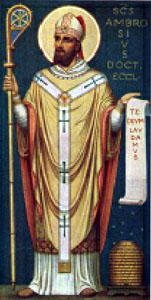
Image of a famous Church father: St. Ambrose (340-397) [bishop of Milan and the teacher of St. Augustine]

Labels: , ,

Monday, August 14, 2006

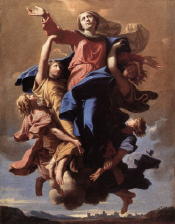
Maria Assumpta Est! (Mary is Assumed!)


Tomorrow (August 15) is the feast of the Assumption of the Blessed Virgin Mary into Heaven.
A great way to celebrate this wonderful feast day (besides attending Mass—this is a Holy Day of obligation, remember) is to take a little time to study the Church's teaching on the dogma of the Assumption.
OK, here is a test for how well you know your faith. Can you explain what this doctrine is?

Let's go to the Catechism of the Catholic Church for help:


966. “Finally the Immaculate Virgin, preserved free from all stain of original sin, when the course of her earthly life was finished, was taken up body and soul into heavenly glory, and exalted by the Lord as the Queen over all things, so that she might be the more fully conformed to her Son, the Lord of lords and conqueror of sin and death” [Lumen Gentium 59, Pius XII Munificentissimus Deus (1950)]. The Assumption of the Blessed Virgin is a singular participation in her Son's Resurrection and an anticipation of the resurrection of other Christians.

Did you get all that? OK, let's analyze this piece by piece.

1.“the Immaculate Virgin, preserved free from all stain of original sin:

This, of course, is the central Marian dogma—the Dogma of the Immaculate Conception. By a unique and singular grace of God, Mary was kept from the stain of Original Sin... This was a GIFT from God: it was the result of the grace of God... the grace that would come as result of Jesus Christ's passion, death, and resurrection.
You might ask, how could God give grace to Mary BEFORE Jesus won that grace for her on the Cross in Cavlary. Remember, God is eternal... God is not bound by time, He is outside of time. God has the power to apply to any man or woman the grace that will result from a future event. At any rate, Mary was conceived free from all stain of original Sin (just as Adam and Eve were), SO THAT she could be COMPLETELY FREE to say YES or NO at the Annunciation. If Mary was burdened with Original Sin, she would have been (like the rest of us), slaves to sin, slaves inclined to doing our own will rather than the will of God.

2. “When the course of her earthly life was finished:

The dogma as stated does not say definitively whether or not Mary died, and then was assumed body and soul to heaven... or whether she was just taken up without having to actually undergo death. This is a matter of theological speculation, people are free to entertain their own theories because it not defined as part of the dogma. Note also that Jesus “ascended” (went up) into heaven by his own power—as God. Mary, was “assumed”... drawn up to heaven by the power of God... not by her own power. Although she is the most perfect of creatures--the Immaculate, Mary is still a creature, after all. Do not get that aspect of the “assumption” and the “ascension” confused as some do. Remember also, that the Bible speaks of two previous “assumptions” into heaven: Enoch (Gen 5:24) and Elijah (the fiery chariot—2 Kings 2:11).

3. “so that she might be the more fully conformed to her Son, the Lord of lords and conqueror of sin and death” ...
4. “a singular participation in her Son's Resurrection and an anticipation of the resurrection of other Christians.”


What happened to Mary is unique (a singular gift). She is the only one who is PERFECTLY in God's presence (not just her soul, but she is complete as a person—soul AND glorified body, living in communion with the Holy Trinity in heaven). The other saints are in God's presence in heaven, but the consummation/perfection of their heavenly life will come at the end of time—with the Resurrection of the dead, when everyone has their bodies restored to them. Jesus loved His mother so much, and they were so close, that he gave Mary an “advance payment” you can say... she is enjoying the full fruits of His victory over death now. We are all destined to be conformed to Jesus Christ—that has already begun with our baptism, and it is nourished every time we receive the sacraments. But, Mary is already fully conformed to Jesus. So, this dogma of the Assumption teaches us about Mary's existence body and soul into heaven so that we can look to her as a sign of our future hope. What she is now, glorified in heaven, in the presence of God—Father, Son, and Holy Spirit—we one day can hope to be! Praise God!

The newly published Compendium of the Catechism of the Catholic Church states this last point nicely:

199. In what way is the Blessed Virgin Mary the eschatological icon of the Church?
Looking upon Mary, who is completely holy and already glorified in body and soul, the Church contemplates in her what she herself is called to be on earth and what she will be in the homeland of heaven.

[“eschatological” is a theological term that refers to the phenomena associated with the end of time, what we traditionally refer to as the 4 “last things”--Death, Judgment, Heaven, Hell. “eschata” is Greek for “last things”]

WAIT, YOU ARE NOT DONE YET....

Check out this article on the Assumption:
http://www.crossroadsinitiative.com/library
_article/190/Assumption_of_the_
Blessed_Virgin_Mary.html


Understand and Explain the Assumption to your non-Catholic Christian friends:
http://www.catholic.com/library/
Immaculate_Conception_and_Assum.asp


You can listen to an MP file of a radio program on the Assumption (Catholic Answers Live):
Go to August 15 on the callendar, "Maria Assumpta Est"
http://www.catholic.com/radio/calendar.php


Here is a homily by doctor of the Church St. John Damascene (d. 749)

This reading on the Assumption of Mary is taken from the first homily of St. John Damascene on the Assumption of the Blessed Virgin Mary.

“But even though, according to nature, your most holy and happy soul is separated from your most blessed and stainless body and the body as usual is delivered to the tomb, it will not remain in the power of death and is not subject to decay. For just as her virginity remained inviolate while giving birth, when she departed her body was preserved from destruction and only taken to a better and more divine tabernacle, which is not subject to any death . . . Hence I will call her holy passing not death, but falling asleep or departure, or better still, arrival. . . .

"Your stainless and wholly immaculate body has not been left on earth; the Queen, the Mistress, the Mother of God who has truly given birth to God has been translated to the royal palaces of heaven. .

"Angels and archangels have borne you upwards, the impure spirits of the air have trembled at your ascension. The air is purified, the ether sanctified by your passing through them. . . the powers meet you with sacred hymns and much solemnity, saying something like this: Who is she that comes forth as the morning rising, fair as the moon, elect like the sun? [cf. Cant 6:9] How you have blossomed forth, how sweet you have become! You are the flower of the field, a lily among the thorns [Cant 2.1] . . . Not like Elijah have you entered heaven, not like Paul have you been rapt to the third heaven; no, you have penetrated even to the royal throne of your Son himself . . . a blessing for the world, a sanctification of the universe, refreshment for those who are tired, comfort for the sorrowing, healing for the sick, a port for those in danger, pardon for sinners, soothing balm for the oppressed, quick help for all who pray to you. . .

“Good Mistress, graciously look down on us; direct and guide our destinies wheresoever you will. Pacify the storm of our wicked passions, guide us into the quiet port of the divine will and grant us the blessedness to come.”

Labels: , , , ,

Monday, July 24, 2006

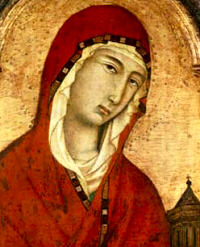
Will the REAL Mary Magdalene please stand up?


St. Mary Magdalene, pray for us!

Saturday (July 22) was the feast of St. Mary Magdalene.
Mary Magdalene has received a great deal of buzz lately due to her role in the DaVinci Code blockbuster. I am told that the novel has some rather fanciful things to say about her. According to Catholic author and apologist Jimmy Akin, “if one wants to force Jesus into the role of being married, Mary Magdalene is one of the few prominent and (seemingly) available women to be pushed into the role of being his wife” (Cracking the DaVinci Code, p. 29). Why is this so? Mary Magdalene is one of the few women disciples of Christ who is prominent, whose name we know, and whom we don’t know was married to someone else. Other female disciples of Jesus were either known to be married to others (Joanna the wife of Chuza--Lk 8:3) or were too insignificant ("the other Mary"--Mt 28:1) or went unnamed in the Gospels (the Syro-Phoenecian woman--Mt 15:28).
Of course, the Magdalene was NOT married to Jesus. What we DO know about Mary of Magdala comes to us from Scripture.

We know Jesus cast 7 demons out of Mary Magdalene and that she was among some of the women who then followed and ministered to Christ in Galilee (Luke 8:2). A long-enduring tradition in the Church has also labeled Mary as a former prostitute, identifying her with the unnamed sinful woman who anointed Jesus’ feet in Luke 7:36-50 (see also Jn 12:1-8). Many contemporary Scripture scholars refute this identification and argue that there is no scriptural evidence that Mary was a prostitute (see the New Jerome Biblical Commentary, for example). Whatever the case, we can at least assume that she was a sinner like the rest of us, and was 100% devoted to Jesus after he had healed her—her love knew no bounds! (Jesus' words would still apply to Mary--"her many sins have been forgiven; hence, she has shown great love"--Lk 7:47)

St. Mary Magdalene’s true legacy can be found in the fact that she was among 2 other women to first see the empty tomb on Easter Sunday morning (Mk 16:1-8). Mark’s gospel states that the Risen Christ first appeared to Mary (Mk 16:9) and commissioned her to announce his coming heavenly ascension to the apostles (Mk 20:11-18, Jn 20:17). The Byzantine tradition calls Mary “the apostle to the apostles” for it was she who first announced the good news to them: “I have seen the Lord” (Jn 20:18).

So, while many of us like to read fiction because such books can “tell a great story.” We must remember, however, that when it comes to our Lord and the saints, we already have stories of true beauty in the Gospels… stories that can teach us essential truths about the spiritual life. Let’s not forget to reflect upon St. Mary Magdalene’s life so that we can grow closer to our Lord. (That is, I am sure, what she desires for us as she enjoys heaven.)

For a short/snappy meditation on St. Mary Magdalene, see the following link: http://www.wau.org/meditations/meditations.asp?month=7&day=22&year=2006&x=13&y=5
For information on the DaVinci Code, see the following link:
http://www.catholic.com/library/cracking_da_vinci_code.asp

---------------------
Now, I will include a homily on St. Mary Magdalene from another wonderful saint, church father, and doctor of the Church—St. Gregory the Great, pope, who lived from 540-604 ad. (this homily is found in the Liturgy of the Hours, the Office of Readings for July 22; Hom. 25, 1-2.4-5: PL 76, 1189-1193)

Gospel: John 20:1-2, 11-18

When Mary Magdalene came to the tomb and did not find the Lord’s body, she thought it had been taken away and so informed the disciples. After they came and saw the tomb, they too believed what Mary had told them. The text then says: The disciples went back home, and it adds: but Mary wept and remained standing outside the tomb.

We should reflect on Mary’s attitude and the great love she felt for Christ; for though the disciples had left the tomb, she remained. She was still seeking the one she had not found, and while she sought she wept; burning with the fire of love, she longed for him who she thought had been taken away. And so it happened that the woman who stayed behind to seek Christ was the only one to see him. For perseverance is essential to any good deed, as the voice of truth tells us: Whoever perseveres to the end will be saved.

At first she sought but did not find, but when she persevered it happened that she found what she was looking for. When our desires are not satisfied, they grow stronger, and becoming stronger they take hold of their object. Holy desires likewise grow with anticipation, and if they do not grow they are not really desires. Anyone who succeeds in attaining the truth has burned with such a great love. As David says: My soul has thirsted for the living God; when shall I come and appear before the face of God? And so also in the Song of Songs the Church says: I was wounded by love; and again: My soul is melted with love.

Woman, why are you weeping? Whom do you seek? She is asked why she is sorrowing so that her desire might be strengthened; for when she mentions whom she is seeking, her love is kindled all the more ardently.

Jesus says to her: Mary. Jesus is not recognized when he calls her “woman”; so he calls her by name, as though he were saying: Recognize me as I recognize you; for I do not know you as I know others; I know you as yourself. And so Mary, once addressed by name, recognizes who is speaking. She immediately calls him rabboni, that is to say, teacher, because the one whom she sought outwardly was the one who inwardly taught her to keep on searching.

Labels: , ,