Friday, May 30, 2008

St. Augustine on the House Built on Rock


Commentary on this week's Gospel: 9th Sunday in Ordinary Time

Matthew 7:21-27

The House Built on Rock, The House Built on Sand


From St. Augustine's exposition of the Sermon on the Mount:


87. Hence we must take special notice how terribly the conclusion of the whole sermon is introduced: “Therefore, whosoever heareth these sayings of Mine, and doeth them, is like 242 unto a wise man, which built his house upon the rock.” For no one confirms what he hears or understands, unless by doing. And if Christ is the rock, as many Scripture testimonies proclaim 243 that man builds in Christ who does what he hears from Him. “The rain descended, and the floods came, and the winds blew, and beat 244 upon that house; and it fell not: for it was founded upon a rock.” Such an one, therefore, is not afraid of any gloomy superstitions (for what else is understood by rain, when it is put in the sense of anything bad?), or of turnouts of men, which I think are compared to winds; or of the river of this life, as it were flowing over the earth in carnal lusts. For it is the man who is seduced by the prosperity that is broken down by the adversities arising from these three things; none of which is feared by him who has his house founder upon a rock, i.e. who not only hears, but also does, the Lord’s commands. And the man who hears and does them not is in dangerous proximity to all these, for he has no stable foundation; but by hearing and not doing, he builds a ruin. For He goes on to say: “And every one that heareth these sayings of Mine, and doeth them not, shall be like unto a foolish man, which built his house upon the sand: 245 and the rain descended, and the floods came, and the winds blew, and beat 246 upon that house; and it fell: and great was 247 the fall of it. And it came to pass, when Jesus hid ended these sayings, the people were astonished at His doctrine: for He taught them as one having authority, and not as their scribes.”248 This is what I said before was meant by the prophet in the Psalms, when he says: “I will act confidently in regard of him. The words of the Lord are pure words: as silver tried and proved in a furnace of earth, purified seven times.” 249 And from this number, I am admonished to trace back those precepts also to the seven sentences which He has placed in the beginning of this sermon, when He was speaking of those who are blessed; and to those seven operations of the Holy Spirit, which the prophet Isaiah mentions; 250 but whether the order before us, or some other, is to be considered in these, the things we have heard from the Lord are to be done, if we wish to build upon a rock.


242 Similis est… Vulgate, assimilabitur. Meyer, Tholuck, etc, refer this to the future judgment, “I will make him like,” etc., when Christ will establish those who keep His sayings for ever (opposed by Alford etc)..

243 (1Co 10,4, Alford, who thinks this signification too plain to overlooked.

244 Offenderunt; Vulgate, irruerunt.

245 The transitory teachings and institutions of men as opposed to Christ’s own word.

246 Offenderunt; Vulgate, irruerunt.

247 Facta est; Vulgate, fuit.

248 Vulgate adds et Pharisaei. The people were astonished, not merely at His teachings, but the dignity and self-consciousness with which Christ uttered them, quod nova quaedam majestas et insueta hominum mentes ad se raperet (Calvin). The Scribes spoke as expounders of the law, and referred back to Moses for their authority; Christ spoke in His own name, and as an independent legislator, vested with greater authority than Moses and a higher dignity. The Scribes by elaborate sophistry often drew many meanings from a single precept, and burdened the people with an intricate and endless variety of precepts for the details of conduct, laying painful stress upon their observance; Christ directed attention from outward acts to the motive and intent of the heart. “He opposed a genuine righteousness to the mock righteousness of the Scribes and Pharisees.”

249 (Ps 12,5-6.

250 (Is 11,2-3).

Labels: , ,

Wednesday, March 19, 2008

Archbishop Hanus Reflects on Hope at Chrism Mass


Chrism Mass homily of Archbishop Jerome Hanus, OBS, March 18, 2008:

Last November, Pope Benedict XVI published his second encyclical: Spe Salvi. It deals with Christian hope.
I began studying it and using it for meditation in the month of December. At the same time, I was also very much preoccupied with my ninety-eight-year-old mother, who was getting weaker by the day. I visited her several times last year, and we would talk about her approaching death and her hope for eternal life.
One section of Pope Benedict’s new encyclical has the title "Eternal life–what is it?" The Holy Father asks the question, "Is the Christian faith also for us today a life-changing and a life- sustaining hope?" (10).


Certainly it was for my mother. Her life and her dying would not have made sense without her faith.
The Pope invites us to think about when it all starts for us Christians. He paints the scene of parents bringing their child to be baptized. He makes use of the classic form of infant baptism found in the Roman Ritual for centuries. The priest first of all asks the parents what name they had chosen for their child. Then he continues with the question, "What do you ask of the Church?" The parents answer, "Faith." Then comes the next question, "What does faith bring you?" And the parents answer, "Eternal life."


Our faith is the key to eternal life. Mom was able to live the kind of life she did because of the gift of faith which she received at baptism. She was able to endure with dignity the sufferings and hardships of life, especially the pain and sufferings of her last years, because she had a great hope in eternal life.


So the Pope makes this initial point in his encyclical: because we believe, we hope.

But Benedict XVI doesn’t just leave it there. He asks another question. (We are coming to understand that this Pope appreciates the questions which contemporary human beings have.) As he reflects on faith and hope leading to eternal life, he asks, "Do we really want this – to live eternally?"

Then he observes that "perhaps many people reject the faith today simply because they do not find the prospect of eternal life attractive. . . . To continue living forever – endlessly – appears more like a curse than a gift. Death, admittedly, one would wish to postpone for as long as possible. But to live always, without end – this, all things considered, can only be monotonous and ultimately unbearable."
Certainly that is the experience of many. Human life, because of sin, because of illness and tragedies, because it is often full of sorrow and suffering, can become almost unbearable.
The Holy Father is touching on the very heart of our human existence. "On the one hand, we do not want to die; above all, those who love us do not want us to die. Yet on the other hand, neither do we want to continue living indefinitely . . . " (11).

In the course of this encyclical, the Holy Father calls our attention to several individuals who are powerful models for Christian hope. The story of one is particularly appropriate to recall as we celebrate this Chrism Mass during which oil will be blessed for use in the life of the Church.

This model of Christian hope is probably not known to most of us. But she is the patron saint of the Sudan. Her name is Saint Josephine Bakhita [pictured above]. She was born in the second half of the 19th century, in Darfur – a name well-known to us today because of the tragic condition of that part of the world. When she was only nine, she was kidnapped by slave traders. She was sold in the slave markets of northern Africa, not just once but several times. Each of her masters treated her horribly. They worked her unbelievably hard for a child; they abused her physically and in many other ways. They even branded her with knives, rubbing salt in the wounds so that she would be permanently scarred.

Her awful life took somewhat of a turn for the better when she was purchased by an Italian businessman and brought to Venice, Italy. A different Italian family took possession of her. In her last years as a teen, she worked more as a nanny to a young daughter of the family. Then she began to learn about Christianity.
Up to this point in her life, the only masters she knew were those who had abused and enslaved her. Now she learned that there was a Master, a divine Master, who didn’t hurt people. Rather, this divine Master was kind and good, goodness in person. This Master had created her, loved her now, cared about her, and was inviting her to a life that was completely different than what she had experienced. "What is more, this master had himself accepted the destiny of being flogged and now he was waiting for her ‘at the Father’s right hand.’ Now she had ‘hope’ – no longer the modest hope of finding masters who would be less cruel, but the great hope: [Listen to what she later wrote in her memoirs] ‘I am definitively loved and whatever happens to me – I am awaited by this Love. And so my life is good’" (3).

In her 21st year, "On 9 January 1890, she was baptized and confirmed and received her first Holy Communion from the hands of the Patriarch of Venice" (3).

The sacred oils used in those sacraments must have meant so much to her. The words of the prophet Isaiah, proclaiming that a suffering servant would come on a mission of salvation, brought her such joy. Saint Josephine Bakhita heard Jesus, her new Master, saying, "The Spirit of the Lord is upon me, because he has anointed me to bring glad tidings to the poor. He has sent me to proclaim liberty to captives" (First Reading and the Gospel for the Chrism Mass).

Prior to her baptism, she had been "without God" and "without hope" (cf. Ephesians 2:12). Through her baptism, she received the gift of faith. This faith gave her hope and filled her with longing for eternal life.
Jesus showed her that there is a God, One who is not an indifferent, distant being, unconcerned about us. God rather is a Person who loves us, creates us, sustains us, and comforts us. Jesus showed her how to live, how to hope, and how to die.

In her last years, she suffered many physical ailments. She was confined to a wheelchair and her body marked by pain and disease. Mentally she suffered the trauma of remembering her years in slavery. But she bore all of this with a great sense of hope. She died in 1947. Like my mother, and like millions of other Christians, she was anointed with the oil of the sick. With that sacred anointing, Christians are united once again with Jesus, the Christ, the anointed One.

What a gift – those sacred oils! What a gift all the sacraments are! And what a privilege is ours, my brother priests, to be able to share God’s comfort with the sick and the dying in the Sacrament of the Anointing of the Sick.

We also are privileged to use the oil of catechumens and the Chrism in the Sacrament of Baptism. Thousands of young people and many adults will be anointed with the Chrism in the Sacrament of Confirmation. I will be the privileged but unworthy instrument, the bishop, acting in the person of Christ, using the sacred chrism, to anoint our next priest in the Archdiocese, Deacon Rodney Allers, who is assisting at today’s liturgy.
He will become a member of this presbyterate, joining his energies to those of his brother priests, who work so hard to be faithful ministers of Christ the High Priest, leading the people to Jesus the fountain of their salvation (cf. Prayer of the assembly for the priests in the Chrism Mass).

I thank the priests – those present today and those not – for their continued zeal, for their strong faith, for being heralds of hope especially to those who are without hope. Thank you for proclaiming the Gospel, in season and out of season. Thank you for stretching yourselves in selfless service of God’s people. The Chrism of salvation, with which your hands were anointed on your ordination day, was not used in vain.
The Spirit of the Lord came upon you. You were anointed, so that through you the Lord Jesus could heal the brokenhearted, proclaim liberty to captives, and give the people oil of gladness in place of mourning. May Christ continue to strengthen you, to bring to completion the good work he has begun in you (Ordination rite).

Labels: , , ,

Friday, March 14, 2008

St. John Fisher on Spiritual Combat (Psalm 6)

St. John Fisher on Psalm 6, from his Exposition of the Seven Penitential Psalms (1508) [pp. 20-21, Ignatius Press, 1998]: this provides a great reflection on the power of the sacrament of confession:

Psalm 6

1. Unto the end, in verses, a psalm for David, for the octave.
2. O Lord, rebuke me not in thy indignation, nor chastise me in thy wrath.
3. Have mercy on me, O Lord, for I am weak: heal me, O Lord, for my bones are troubled.
4. And my soul is troubled exceedingly: but thou, O Lord, how long?
5. Turn to me, O Lord, and deliver my soul: O save me for thy mercy's sake.
6. For there is no one in death, that is mindful of thee: and who shall confess to thee in hell?
7. I have laboured in my groanings, every night I will wash my bed: I will water my couch with my tears.
8. My eye is troubled through indignation: I have grown old amongst all my enemies.
9. Depart from me, all ye workers of iniquity: for the Lord hath heard the voice of my weeping.
10. The Lord hath heard my supplication: the Lord hath received my prayer.
11. Let all my enemies be ashamed, and be very much troubled: let them be turned back, and be ashamed very speedily.

"The third part of the psalm now follows, where the prophet, trusting to have been forgiven indeed, rejoices in himself with a bold and hardy spirit. The virtue and strenght of the grace of God is marvellous, for when it pierces and enters the soul of any creature, it causes him to be bold and to hope well, so much so that he dares now to make fresh battle against his enemies. Take heed and behold the sudden change in this prophet caused by the goodness of God: whereas he was only lately vexed and troubled with fear and dread, now, comforted by the grace of almighty God, he has the audacity to despise his enemies and to command them to go away from him saying: discedite a me omnes qui operamini iniquitatem, I command you, all you doers of wickedness, to go from me. Truly the doers of wickedness are those who are busy causing sins to be done, such as the damned spirits by whose enticement sin first entered into man's soul. Of this disposition are the wicked and malicious devils who never do anything but craftily deceive men's souls with their frauds and bring them into the snares of sin. Therefore, the prophet says to them, discedite a me omnes qui operamini iniquitatem, go from me all you doers of wickedness. He shows the reason why they ought to go from him, that he no longer belongs to them. While he was the servant of sin, he was under the power of Satan and his ministers, but now, since he has turned himself to almighty God by true penance and has utterly cast away and forsaken his sins, he is completely delivered from the power of the devils.

Labels: ,

Tuesday, January 15, 2008

St. Cyril of Alexandria on spiritual warfare


I am currently reading St. Cyril of Alexandria's (376?-444) Commentary on the Gospel of Luke. His words on the parable of the sower and the seed (Lk 8:5-8)--especially as he treats of the seed that falls on rock (I thought this was apropriate given our most recent men's group discussion on spiritual warfare):

"And next, let us consider those others of whom Christ said, And those upon the rock are they who, when they hear, receive the word with joy, and they have no root; these for a while believe, and in time of temptation depart away. For there are verily [truly] men whose faith has not been proved, depending on words simply, and not applying their mind to the examining of the mysteries; of such the piety is sapless and without root. For when they enter the churches, they feel pleasure often in seeing so many assembled, and joyfully receive instruction in the mysteries from him whose business it is to teach, and laud him with praises; but this they do with no discretion or judgment, but with unpurified wills; and when have gone out of the churches, at once they forget the sacred doctrines, and proceed their customary course; not having stored up within them any thing for their future benefit. And if the affairs of Christians go on peacefully, and no trial disturb them, they even then scarcely maintain in them the faith, and that, so to speak, in a confused and tottering state. But if persecution trouble them, and the enemies of the truth attack the churches of the Savior, their heart loves not the battle, and their mind throws away the shield and flees being devoid of zeal, and destitute of love towards God, and ready for desertion. But O ye fearful and infirm, one may well say, why do ye flee from that which would be your glory? And escape from conflicts to which ye have been trained? For hereby those who wish may win for themselves the trophy of victory. Do ye also struggle; twine the chaplet of manliness, thirst for the rewards of perseverance, for the honors of patience.

"…Therefore, as the prophet Jeremiah has said, Take up arms and shields (Jer 46:3). Especially as the right hand of God our savior is invincible in battle, and as most wise Paul has said, He does not permit men to be tried more than they can bear, but with the trial will also come the way of egress [return], that they may be able to endure patiently. (1 Cor 10:13)

"…He [Christ] laid down his life for us, and with His blood purchased the world. We are, therefore, not our own, but His Who bought and redeemed us, and to whom we owe our lives. For as the divine Paul said, For this reason Christ died and lived, that He might be Lord of the dead and the living. (Rom 14:9) We ought, therefore, to possess a mind incapable of being shaken, that especially whenever temptation arrive, we may show ourselves approved and victorious in the power of patience; and ready with joy to undergo conflicts, and seize the opportunity of suffering for piety’s sake towards Christ."

More on St. Cyril, the "doctor of the Incarnation":

http://www.catholic.org/saints/saint.php?saint_id=616

Labels: , ,

Friday, January 04, 2008

Even St. Augustine has a MySpace!


I heard about this St. Augustine MySpace profile. I imagine that some Augustinian priest or brother created this? I am not sure whether your average MySpace user would actually read the meaty blog posts of his Confessions, but this is a neat idea. [PS: just finished listening to Confessions via audio book, it is a must read/hear]


Labels: , , , , ,

Friday, November 09, 2007

an interesting film: saints counsel a young boy on how to deal with found money


Just watched an interesting British movie entitled "Millions" (2005) available on Netflix:

http://www.netflix.com/Movie/Millions/
70011208?trkid=90529


Netflix description:


Acclaimed director Danny Boyle posits a tantalizing question in this engaging film: What happens when two boys stumble upon a cache of cash? Damian (Alex Etel) and his brother, Anthony (Lewis McGibbon), find a satchel filled with British pounds, but with the country just days away from switching to the Euro, they must quickly find a way to spend and share the wealth. Trouble is, Damian wants to give to the poor, while Anthony aims to live it up. Rated PG; 1 hr, 38 min., 2005

My remarks:
This is a decent film with an interesting premise: saints appear to a boy to give him advice in what to do with a moral problem (how to spend found money). The youngest son, Damian, who knows and loves the saints the same way many boys can spit out the stats off of the baseball cards of their favorite players (Damian identifies the saints who appears to them and states the years they lived or their patronage). St. Clare of Assisi, St. Francis, St. Joseph, and St. Nicholas all appear to Damian in some funny scenes (though it is odd to here St. Clare with a British accent, just as it is odd to see her casually smoking a cigarette--in heaven, would such run-of-the-mill vices be the mark of our joy, peace, and freedom?).
Actually, I think that the scenes with the saints could have been more developed--there is a lot of clever things they could have done.
Still, this is an interesting take on how money can seem at first like the answer to prayers only to cause greed, division, and further conflict. Damian's character finds the money (bound to be destroyed by the government as they make the switch to Euro) when a burglar throws the bag of British pounds off of a train. The money falls into Damian's play fort and he assumes that it came from God. Damian feels that his mission is to give the money to the poor--which, as he finds out, is not as easy to do as one would think. Damian's brother Anthony uses the money to buy expesive gifts and impress his school friends. Finally, the father finds the money and must conquer his own demons, and decide between greed or doing the right thing.
One caveat: St. Peter has a conversation with Damian about how much of an impact one person's well-intentioned actions can cause. He then recounted the story of the miracle of the multiplication of the loaves. He actually spewed out the tired old historical-critical interpretation: Jesus did not ACTUALLY multiply the loaves. Rather, he encouraged all those around him to shed their selfish hoarding and share the bread they had hidden under their cloaks. THAT, he pleads, was the REAL miracle. And I roll my eyes.
All in all, some good themes, and, if select highlight scenes are shown, could be good for classroom catechesis.
The movie is PG and is free from foul language (to my recollection), and excessive violence. There is one short scene where the boys see a coumputer add for bras that makes visible a woman's breast. Lastly, there is a scene where the widower father is in bed with a woman that he meets who befriends him and the boys (no visible nudity, just the implication of a pre-marital fornication).

Labels: , , , ,

Monday, October 01, 2007

bite-size wisdom: St. Therese, "the Little Flower"


Since Our Lord is in heaven
I can only follow him by the traces of light and fragrance
which he has left behind him.
But as soon as I open the Holy Gospels, I breathe the perfume
exhaled by the life of Jesus,
and I know which way to run.
It is not to the highest place
but to the lowest that I hasten.
-St. Therese of Lisieux, Manuscript B, Story of a Soul
quoted in Therese of Lisieux: In My Own Words (Liguori Press)
Feast Day: October 1st
"When you are invited by anyone to a marriage feast, do not sit down in a place of honor, lest a more eminent man than you be invited by him; and he who invited you both will come and say to you, 'Give place to this man,' and then you will begin with shame to take the lowest place. But when you are invited, go and sit in the lowest place, so that when your host comes he may say to you, 'Friend, go up higher'; then you will be honored in the presence of all who sit at table with you. For everyone who exalts himself will be humbled,
and he who humbles himself will be exalted."
(Luke 14:8-11)

Labels: , , ,

Thursday, September 27, 2007

Mother Theresa's spiritual darkness: faith is about TRUST,... not certitude and clarity


This is an interesting article about the current talk of Mother Theresa's spiritual darkness as revealed in a new publication of letters to her spiritual director entitled Come Be My Light.
[ Mother Teresa: Come Be My Light ]

Jesuit Fr. John Kavanaugh is a gifted theologian (for an example of his work see entitled
Following Christ in a Consumer Society:
The Spirituality of Cultural Resistance

_______________________________________
Godforsakenness
'Finding one's heart's desire'
By
John F. Kavanaugh OCTOBER 1, 2007 AMERICA
[http://www.americamagazine.org/
content/article.cfm?article_id=10235


There has been much written about Mother Teresa of Calcutta these days. Not only has the 10th anniversary of her death been observed; depths of her interior life have been inspected as well. The publication of her letters to spiritual directors in Mother Teresa: Come Be My Light, edited by Brian Kolodiejchuk, M.C., has revealed that the founder of the Missionaries of Charity herself lived in profound spiritual darkness for nearly 50 years.

The public revelation of Mother Teresa’s interior crisis (much of the documentation appeared on the Internet news site zenit.org in 2002, while the cause for her canonization was moving forward) has struck some as a cruel betrayal of her desire not to have her letters published. Others were shaken by what seemed to be her loss of faith or by God’s harshness with her. Some have linked her experience with the harrowing purifications of high mystical prayer.

The most voluble response has likely been that of Christopher Hitchens. An often brilliant polemicist and eminently readable essayist, Hitchens is perhaps the most prominent of nonbelievers to have recently published an anti-theist manifesto. His best-seller is titled God Is Not Great: How Religion Poisons Everything. But over a decade ago he wrote The Missionary Position, a searing and often mean indictment of Mother Teresa, whom he dubbed the "Ghoul of Calcutta."

There is a puzzling zeal in Hitchens’s fascination with Mother Teresa and his seizure of every media opportunity to disparage her. He opined in the Time magazine cover story (a remarkably balanced article) that she was like a die-hard, disillusioned Communist carrying on even though things were falling apart. On television news shows he attributed her perseverance to the fact that "advisors egged her on because she was a great marketing tool."
Apparently the only good thing he can see in her life is what he thinks was her loss of faith. Thus, from his two-page opinion piece in Newsweek one gets the sense that Hitchens has discovered a strange sympathy for "this troubled and miserable lady." But first he must convince himself that she has really lost her faith. Thus he moves from his first paragraph’s guarded "all but lost her own faith" and "for all practical purposes ceased to believe," to his ringing conclusive indictment of "a blind faith in which she herself had long ceased to believe."

Hitchens gave a much more accurate description of Mother Teresa’s crisis during a three-hour interview on C-Span’s "Book TV." Correcting himself after asserting her loss of faith he said, "If not a loss of faith, a great loss of certainty." Precisely.
The problem (and Hitchens could not have suspected it) is that Mother Teresa never had certainty. At least that’s what she told me.

In Calcutta during December 1975 and for a few days in the following March, I was doing the "long experiment of humble ministry" that Jesuits undertake during their last year of formation. On those days when I celebrated the Eucharist at the Missionaries of Charity motherhouse and worked at the House of the Dying, I had a number of conversations with Mother Teresa.

Two of them still inhabit my life. Our first talk concerned my worry that I should not go back to the comfort and riches of being a university professor in the United States. She told me to go back. "There is far greater poverty there. The greatest poverty is the absence of love."
Much more puzzling was a comment she made shortly before I left Calcutta. I had asked her to pray for me. She said "for what?" "For clarity," I pled. And she immediately said no, she would not pray for that. I complained that she seemed always to have clarity and certitude. "I’ve never had clarity and certitude," she said. "I only have trust. I’ll pray that you trust."
So Hitchens is correct on at least one count. Mother Teresa was living with a "great loss of certainty"—about herself, about her relationship to Christ, about her fate, about her very God. The feeling of not having faith is quite different from not having faith. Otherwise it would not be so harrowing to the believer, who cries out with nothing but trust.

It would be good if all of us, believer and nonbeliever alike, could learn once and for all that whatever faith is, it is not a crutch. Sometimes in faith, you have nothing to lean on. Nor is the "feeling" or consolation of faith something we can conjure up on our own. If anyone had such powers of conjuring it would be Mother Teresa. So much for feel-good religion—that "opiate of the masses." Morphine is much more effective.

The real story, the deepest subtext, in Mother Teresa’s "dark night" is not that God was purifying her. God was actually giving her her heart’s desire.

Every Missionaries of Charity community I have visited has a large crucifix with the words "I thirst" over it. It is that broken man on the cross that Mother Teresa most wanted to identify with, the same Jesus she could see in the most bereft and seemingly unloved of her brothers and sisters on earth. In one of her desperate cries to Jesus she wrote, "Lord my God, who am I that you should forsake me?" Is it possible that she could not see that her very words were the same as those uttered by the man on the cross she so longed to be with? Could she not realize that she had finally found union with the man who cried, "My God, my God, why have you forsaken me?" Perhaps it is best that she did not appreciate the intensity with which her prayers were answered. Freed from her darkness, she would have left him to his cross. Such can be the paradox of finding one’s heart’s desire.

John F. Kavanaugh, S.J., is a professor of philosophy at St. Louis University in St. Louis, Mo.

Labels: , , , ,

Sunday, July 01, 2007

St. Michael the Archangel... defend us in battle


Just finished this icon of St. Michael (based on the original from Solrunn Ness)

Labels: ,

Tuesday, March 20, 2007

A book review on St. Joan of Arc

The following is a book review from the washingtonpost.com. This books sounds interesting and is written by a man of faith. However, the headline of the review makes me a little nervous ("On Her Own Terms"). We Americans seem to love the story of saints who buck ecclesiastical authorities (we saw this in the coverage of the newly canonized St. Theodore Guerin). Of course, in this, and many other cases, the Church leaders were in the wrong, but journalists fail to note that saints practice obedience first to God--and not prideful disobedience to authority just for its own sake (the ole' "I did it MY way"). Shea's review also mentions that St. Joan was targeted because she was a woman of power in a world dominated by "male clergy" and because she received revelations from God without the mediation of a priest. That may be the case, but I wonder if there is a little bit of radical feminism in the back of Shea's (or Spoto's) mind. The point about private revelations independent of the clery is perfectly vaild. Throughout history God has given private revelations directly to men, women, and children. Priests exist primarily to give Christians the sacraments--most especially the Eucharist--and not to be the sole source for truth from God. God gave private revelations to St. Joan, but He gave her the Eucharist (without which she would admit she would be nothing) through the ministry of priests. While St. Joan unfortunately was persecuted by churchmen, she never would have considered herself as independent of the Church or outside of the Church. This book sounds like an interesting read. Now, for the review:

On Her Own Terms
By Rachel Hartigan Shea, a contributing editor of Book WorldTuesday, March 20, 2007; Page C03


JOAN:
The Mysterious Life of the Heretic Who Became a Saint
By Donald Spoto
HarperSanFrancisco. 222 pp. $24.95


What is a modern reader to make of the story of Joan of Arc? A country girl hears voices she says are from God, persuades an uncrowned king to put her at the head of his army, wins a crucial battle and changes the course of history. She seems pure myth and yet is a historical fact. Modern minds shy away from the myth and try to explain away the fact by casting her as "a cunning charlatan, a deluded patriot, a sexually confused peasant . . . or a pitiable psychotic," writes Donald Spoto in "Joan," his slim but compelling paean to the virgin who saved France.

But Joan must be understood on her own terms, argues Spoto, a theologian whose books include biographies of Jesus, Saint Francis of Assisi, Jacqueline Kennedy Onassis and Tennessee Williams. Born in 1411 or 1412 in the tiny French village of Domr?my in the midst of the Hundred Years' War, Joan lived at a time when "the language of faith was like a common country in which all people lived." That God would choose to speak to a young girl in her father's garden would surprise her contemporaries, perhaps, but not shock them.

Nor does it shock Spoto, who approaches his subject with the sophistication of a historian and the admiration of a true believer. "I believe that her spiritual experiences were profoundly valid," writes Spoto, "and that they convey something of the truth." According to him, any theory that strips religion away from Joan's visions in favor of some psychological or medical root cause -- an ear infection producing strange sounds, say, or an eye condition causing light sensitivity -- must ignore her demonstrated sanity and physical health. If the visions "came from the mind of a religious fanatic," he argues, "or a romantic, neurasthenic adolescent, or if they were the specters of an inflamed mind or the deliberately concocted tales of a self-deluded egotist, then we would expect to find -- would have to find -- an accompanying pattern of delusion in her life."

Instead, Spoto discovers that she was "energetic, witty, courageous, and intelligent beyond all expectation." Uncowed by authority, she declared upon meeting Charles VII, "my most eminent lord Dauphin, I have come, sent by God to bring help to you and to the kingdom." The demoralized dauphin, whose kingdom was so racked with civil war and English invaders that he had not yet been crowned king, glowed "radiant" at her words and sent her to lift the English siege of Orl?ans.

Joan's strength was not her military might -- her sword remained unblooded -- but her piousness, which heartened the French soldiers. She had persuaded them of the "grander purpose of their battle: to save France, which was sacred to them and, they believed, to God." When the French prevailed at Orl?ans, after a horrific battle in which hundreds of English drowned in the Loire River from the weight of their armor, "British hegemony in France had been broken, and the survival of France was no longer a dim hope but a distinct probability."

But Joan's moment of great victory led, inexorably, to her downfall. She had succeeded where French military men had not, and she based that success upon direct contact with God, no priestly intercession required. She was a "transforming presence in a world of male warriors, male royalty, and male clergy," writes Spoto. Naturally, men, both French and English, moved to be rid of her. The king, guided by jealous advisers, stopped providing her with sufficient troops. The English set aside special forces to capture her with the aim of trying her for heresy. And captured she was, by a French noble who sold her off to the English.

The trial, held on French soil with a French judge but very much under English control, had only one possible outcome: to burn Joan as a heretic. What else to do with a woman who "is schismatic, sacrilegious, idolatrous, apostate, evil-speaking and evil-doing, blasphemous, scandalous, seditious, a destroyer of peace, a warmonger who thirsts for human blood and urges others to spill it," as one of the charging documents spluttered. Twenty-five years later, when French officials acquitted Joan in a posthumous retrial, it was clear that evidence had been falsified and that she had been tricked into wearing men's clothing one last time, the charge that ultimately sent her to the stake at the age of 19. A minor infraction, it would seem, but, Spoto explains, "to claim male prerogatives was . . . abominable."

As archaic as Joan's life and terrible end appear, Spoto argues for her relevance today: "If Joan was right in her insistence that the unwarranted takeover of one country by another is repugnant, then she is more than a historical curiosity: she remains a prophetic witness for every generation." Yet he goes no further with this political claim, leaving the reader to wonder whether this is an oblique criticism of U.S. foreign adventures or something else entirely. More convincing, even to a nonbeliever, is his contention that Joan saw, or truly believed she saw, visions from God. "The entire Jewish-Christian faith tradition," writes Spoto, "is based on the belief that God once summoned ordinary people and through them worked extraordinary deeds for His own purpose."

On the morning before Joan died, she asked a priest, "Where shall I be tonight?" Spoto, for one, believes he knows the answer.

Labels: , , ,

Wednesday, January 24, 2007

St. Francis De Sales, pray for us!


Today, January 24th, is the feast day of St. Francis De Sales (+1622), a bishop and doctor of the Church. He is noted especially for his spiritual classic Introduction to the Devout Life. [see bottom of post for an on-line link to this classic work]. This would be an excellent book for anyone who would like to begin the practice of spiritual reading... and exploring the incredible treasure of the Catholic mystical/spritual tradition.

The following is a meditation from St. Francis published in the daily devotional/missal Magnificat (www.magnificat.com)

Cultivating the Hundredfold

It is a good thing to aim in a general way at the greatest perfection of Christian life but we should not philosophize about it in detail, unless to consider how we may amend ourselves and advance in the course of the ordinary, everyday happenings of our life; and from one day to the next we should entrust our general wish for perfection to God's providence; and as we look to him for this, we should cast ourselves into God's arms like a little child who in order to grow, simply eats what its father provides day by day, hoping that he will provide according to its appetite and need...

What more can one say to a soul which God has for so long drawn to complete repose in him and in his providence except just this: stay where you are, giving yourself up completely to the will of him who deigns to take care of you. Your only care should be to please him by depending utterly on his love and trusting him... Do this generously, cheerfully, and sweetly and you will find God's graces abounding in you... Ever be joyful with that peaceful and devout joy which is grounded in love of your own abjection, and cultivate a calm and peaceful humility of heart, accepting all sorts of suffering and abjection, not deeming yourself worthy of anything else.

More information on the life of St. Francis De Sales:

http://www.domestic-church.com/CONTENT.DCC/
19990101/SAINTS/stfrancis.htm


http://www.catholic.org/saints/saint.php?saint_id=51


http://www.catholic-forum.com/Saints/saintf03.htm

Read Introduction to the Devout Life on-line [of course, it is easily found at Amazon or most Christian bookstores]:
http://www.ccel.org/ccel/desales/devout_life.html

Labels: ,

Friday, December 29, 2006

Idiot's Guide to Prayer Part II - Awareness of God's indwelling


This is a very nice article from the Cukierski Family Apostolate [ www.cukierski.net ]--an apostolate "specializing in sacramentals of healing and protection." Part of their apostolate is to send spiritual articles via email (free). This is a great article to read during this Christmas season where we focus on the Incarnation--Emmanuel--"God with us." Enjoy.


Where to Find Heaven!
By the late Father Kilian McGowan, C.P. Used withpermission, from the Passionist Priests, to help spiritually guide the layman.

The thin, gray-haired penitent hunched over a rough table as he slowly penned a letter to his sister. Looking at him now, you'd never dream that he had been a French Army officer, an explorer, a member of the Foreign Legion, and even a Trappist. His wild life had caused his expulsion from the Legion, but now he was leading a life more penitential than a Trappist!

"God is in us," the ex-Trappist wrote, "in the depths of our soul, He listens to us-advises us to converse with Him. Train your children to chat freely with this Divine Guest. And may you do likewise. In performing your duties, God will perform them with you. Gradually, you will become accustomed to this sweetCompanion-to this God of your heart."

It was the truth of the Divine Indwelling that had transformed the life of [Blessed] Charles de Foucald [pictured at top left]. He knew by experience what our Lord means when He promised: "If anyone loves me, he will keep my word, and My Father will love him and We will come to him." (John 14:23). De Foucald was constantly aware of the Indwelling of God by grace.

We all envy this wonderful trait. And we often wish that we could be more conscious of the nearness of God. We know that a profound appreciation of this truth alone could refashion our daily lives.

Why aren't we like de Foucald? Perhaps we really aren't convinced that God is anxious to be invited to our interior home-and to be entertained in the depths of our hearts. Listen then to the author of the Imitation [of Christ] : "God pays frequent visits to the interior man. He speaks to him with kindness. He grants him amazing familiarity, an abundant peace, an astonishing familiarity. Oh, grant Him a place there."

For your enjoyment, God decorated the heavens with the sun, moon, and stars. For you, He clothed the earth with the flowers and the fields, the streams and the mountains. But amidst all these wonders and in all the vastness of the universe, there is but one place He designed for His occupancy-and that is yourheart.

A young French Carmelite of the past century also centered her spiritual life on this dynamic truth. Writing to her sister, Sister Elizabeth [of the Trinity] said: "It seems to me that this is the secret of holiness, and how simple it is. We bear life within us and our life is an anticipated heaven...I have found my heaven on earth, for heaven is God-and God is within my soul."

At another time, writing to a married sister, she said: "This heaven is in the inmost center of the soul. Is not this a simple and consoling thought? In th midst of your cares as a mother and housewife, you can always withdraw into this solitude. When you are distracted by your many duties, you can-if youwill-refresh yourself by descending into the depth where your Divine Guest has His dwelling."

There are four ways especially to build up your awareness of God's dwelling inyour soul:

1) Attention. Be thoughtful enough to recall His Presence often. An interior glance takes but a moment; a short prayer, a moment more.

2) Conversation. Speak to your indwelling God frequently. But speak to Him as present. Speak to Him in your own words. Be spontaneous and simple.

3) Renunciation. Firmly resolve to renounce absolutely whatever would evict your Divine Guest. Mortal sin desecrates His Temple and drives God away.

4) Imitation. As imitation is the highest form of praise, strive to be more Godlike in all things. The spiritual life is above all else a loving friendship with the Blessed Trinity. Imitation is the proof of love. Yes, anyone can find his heaven on earth, because Heaven is God-and God is in your soul!

For more information on Blessed Charles De Foucault and his spirituality, see, for example:

http://www.jesuscaritas.191.it/comunita_e.htm

http://www.godspy.com/reviews/Charles-Foucauld-A-life-hidden-with
-Christ-by-David-Scott.cfm

Labels: ,

Thursday, November 09, 2006

Bite-size wisdom (only giving half?)


"We must not belong to God by halves;
as God gives Himself entirely to the soul He loves,
so does He desire to possess the soul's entire love.
-St. Margaret Mary Alacoque
from Thoughts and Sayings of Saint Margaret Mary, TAN Books and Publishers
Who is St. Margaret Mary Alacoque? Find out:

Labels: ,

Tuesday, October 31, 2006

Halloween and All Saints resources

Consider Halloween from the Christian perspective:

Here are some links (via Catholic author Amy Welborn's site: http://amywelborn.typepad.com/ )

Catholic Mom:
http://www.catholicmom.com/halloween.htm

Origins of Halloween and All Saints:
http://www.catholicexchange.com/vm/index.asp?vm
_id=6&art_id=25832


Articles from American Catholic website:
http://www.americancatholic.org/Features/Halloween/

Labels: ,

Sunday, October 22, 2006

A new saint for the U.S. ... and for the world!


From Zenit newservice:

Date: 2006-10-15
Benedict XVI Canonizes 4 Saints
Says They Invested in Heaven

VATICAN CITY, OCT. 15, 2006 (Zenit.org).- Saints gain heaven by trusting in the word of God, said Benedict XVI on proclaiming the sanctity of a bishop, a priest and two women religious. "Their names will be remembered forever," he said today at the canonization Mass of the four saints in St. Peter's Square.

Among those canonized is St. Rafael Guízar Valencia (1878-1938), a bishop of Veracruz, Mexico, who is the first bishop-saint born in Latin America.

St. Teodora Guérin (1798-1856) of France, born Anne-Thérèse, is Indiana's first saint. Sent by the Congregation of the Sisters of Providence to Indiana in 1839, the religious founded St. Mary-of-the-Woods College in Indiana in the United States.

St. Filippo Smaldone (1848-1923) of Italy was a diocesan priest and founder of the Congregation of the Salesian Sisters of the Sacred Heart. He is known as the apostle of those who cannot hear or speak.

St. Rosa Venerini (1656-1728) of Italy, founded the Congregation of Religious Teachers Venerini and the first public school for girls in Italy.

The four new saints left a lesson, Benedict XVI said during the homily of the canonization Mass: "If man puts his trust in riches in this world he does not attain the full meaning of life or authentic joy." "On the contrary, if, trusting in the word of God, he denies himself and his properties for the kingdom of Heaven, he seems to lose much, but in reality gains everything," the Pope said.

"The saint is precisely that man or woman who, responding with joy and generosity to Christ's call, leaves everything to follow him," the Holy Father said. The Pontiff added: "Earthly riches occupy and preoccupy the mind and heart. "Jesus does not say that they are evil, but that they separate us from God if they are not 'invested' so to speak, in the kingdom of heaven, if they are not spent for those who are in poverty."

For more on the life of this holy woman of God St. Theodora Guerin, check out the following links:

Get the story from Catholic News Service!
http://www.catholicnews.com/data/stories/cns/0605689.htm

Archdiocese of Indianapolis (where the saint's religious community resides)
http://www.archindy.org/guerin/

Sisters of Providence of St. Mary-of-the-Woods
http://www.spsmw.org/cgi-bin/site.pl?332&ceNews_newsID=189

Try having your students (especially Confirmation candidates) do some research on the lives of these new saints.

[PS: be careful in what you read (as always). I have already come across some rather bizarre spins on the life of St. Theodore. Apparently she had some run-ins with her local bishop in Indiana. Some Catholic writers who are disenchanted with Catholic Church teaching and the hierarchy have argued that St. Theodore is an example of how today's heretic can be recognized as tomorrow's saint. I do not think that such an idea would do justice to St. Theodore Guerin's devotion to the evangelical counsels of chastity, poverty, and obedience.]

Labels: , , ,

Monday, August 14, 2006

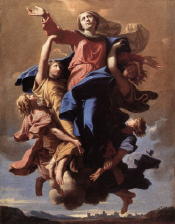
Maria Assumpta Est! (Mary is Assumed!)


Tomorrow (August 15) is the feast of the Assumption of the Blessed Virgin Mary into Heaven.
A great way to celebrate this wonderful feast day (besides attending Mass—this is a Holy Day of obligation, remember) is to take a little time to study the Church's teaching on the dogma of the Assumption.
OK, here is a test for how well you know your faith. Can you explain what this doctrine is?

Let's go to the Catechism of the Catholic Church for help:


966. “Finally the Immaculate Virgin, preserved free from all stain of original sin, when the course of her earthly life was finished, was taken up body and soul into heavenly glory, and exalted by the Lord as the Queen over all things, so that she might be the more fully conformed to her Son, the Lord of lords and conqueror of sin and death” [Lumen Gentium 59, Pius XII Munificentissimus Deus (1950)]. The Assumption of the Blessed Virgin is a singular participation in her Son's Resurrection and an anticipation of the resurrection of other Christians.

Did you get all that? OK, let's analyze this piece by piece.

1.“the Immaculate Virgin, preserved free from all stain of original sin”:

This, of course, is the central Marian dogma—the Dogma of the Immaculate Conception. By a unique and singular grace of God, Mary was kept from the stain of Original Sin... This was a GIFT from God: it was the result of the grace of God... the grace that would come as result of Jesus Christ's passion, death, and resurrection.
You might ask, how could God give grace to Mary BEFORE Jesus won that grace for her on the Cross in Cavlary. Remember, God is eternal... God is not bound by time, He is outside of time. God has the power to apply to any man or woman the grace that will result from a future event. At any rate, Mary was conceived free from all stain of original Sin (just as Adam and Eve were), SO THAT she could be COMPLETELY FREE to say YES or NO at the Annunciation. If Mary was burdened with Original Sin, she would have been (like the rest of us), slaves to sin, slaves inclined to doing our own will rather than the will of God.

2. “When the course of her earthly life was finished”:

The dogma as stated does not say definitively whether or not Mary died, and then was assumed body and soul to heaven... or whether she was just taken up without having to actually undergo death. This is a matter of theological speculation, people are free to entertain their own theories because it not defined as part of the dogma. Note also that Jesus “ascended” (went up) into heaven by his own power—as God. Mary, was “assumed”... drawn up to heaven by the power of God... not by her own power. Although she is the most perfect of creatures--the Immaculate, Mary is still a creature, after all. Do not get that aspect of the “assumption” and the “ascension” confused as some do. Remember also, that the Bible speaks of two previous “assumptions” into heaven: Enoch (Gen 5:24) and Elijah (the fiery chariot—2 Kings 2:11).

3. “so that she might be the more fully conformed to her Son, the Lord of lords and conqueror of sin and death” ...
4. “a singular participation in her Son's Resurrection and an anticipation of the resurrection of other Christians.”


What happened to Mary is unique (a singular gift). She is the only one who is PERFECTLY in God's presence (not just her soul, but she is complete as a person—soul AND glorified body, living in communion with the Holy Trinity in heaven). The other saints are in God's presence in heaven, but the consummation/perfection of their heavenly life will come at the end of time—with the Resurrection of the dead, when everyone has their bodies restored to them. Jesus loved His mother so much, and they were so close, that he gave Mary an “advance payment” you can say... she is enjoying the full fruits of His victory over death now. We are all destined to be conformed to Jesus Christ—that has already begun with our baptism, and it is nourished every time we receive the sacraments. But, Mary is already fully conformed to Jesus. So, this dogma of the Assumption teaches us about Mary's existence body and soul into heaven so that we can look to her as a sign of our future hope. What she is now, glorified in heaven, in the presence of God—Father, Son, and Holy Spirit—we one day can hope to be! Praise God!

The newly published Compendium of the Catechism of the Catholic Church states this last point nicely:

199. In what way is the Blessed Virgin Mary the eschatological icon of the Church?
Looking upon Mary, who is completely holy and already glorified in body and soul, the Church contemplates in her what she herself is called to be on earth and what she will be in the homeland of heaven.

[“eschatological” is a theological term that refers to the phenomena associated with the end of time, what we traditionally refer to as the 4 “last things”--Death, Judgment, Heaven, Hell. “eschata” is Greek for “last things”]

WAIT, YOU ARE NOT DONE YET....

Check out this article on the Assumption:
http://www.crossroadsinitiative.com/library
_article/190/Assumption_of_the_
Blessed_Virgin_Mary.html


Understand and Explain the Assumption to your non-Catholic Christian friends:
http://www.catholic.com/library/
Immaculate_Conception_and_Assum.asp


You can listen to an MP file of a radio program on the Assumption (Catholic Answers Live):
Go to August 15 on the callendar, "Maria Assumpta Est"
http://www.catholic.com/radio/calendar.php


Here is a homily by doctor of the Church St. John Damascene (d. 749)

This reading on the Assumption of Mary is taken from the first homily of St. John Damascene on the Assumption of the Blessed Virgin Mary.

“But even though, according to nature, your most holy and happy soul is separated from your most blessed and stainless body and the body as usual is delivered to the tomb, it will not remain in the power of death and is not subject to decay. For just as her virginity remained inviolate while giving birth, when she departed her body was preserved from destruction and only taken to a better and more divine tabernacle, which is not subject to any death . . . Hence I will call her holy passing not death, but falling asleep or departure, or better still, arrival. . . .

"Your stainless and wholly immaculate body has not been left on earth; the Queen, the Mistress, the Mother of God who has truly given birth to God has been translated to the royal palaces of heaven. .

"Angels and archangels have borne you upwards, the impure spirits of the air have trembled at your ascension. The air is purified, the ether sanctified by your passing through them. . . the powers meet you with sacred hymns and much solemnity, saying something like this: Who is she that comes forth as the morning rising, fair as the moon, elect like the sun? [cf. Cant 6:9] How you have blossomed forth, how sweet you have become! You are the flower of the field, a lily among the thorns [Cant 2.1] . . . Not like Elijah have you entered heaven, not like Paul have you been rapt to the third heaven; no, you have penetrated even to the royal throne of your Son himself . . . a blessing for the world, a sanctification of the universe, refreshment for those who are tired, comfort for the sorrowing, healing for the sick, a port for those in danger, pardon for sinners, soothing balm for the oppressed, quick help for all who pray to you. . .

“Good Mistress, graciously look down on us; direct and guide our destinies wheresoever you will. Pacify the storm of our wicked passions, guide us into the quiet port of the divine will and grant us the blessedness to come.”

Labels: , , , ,

Poetry Break ("Beauty of Creation")

another Poetry Break... because you deserve one.

The Beauty of Creation Bears Witness to God

Question the beauty of the earth,
the beauty of the sea,
the beauty of the wide air around you,
the beauty of the sky;
question the order of the stars,
the sun whose brightness lights the day,
the moon whose splendor softens the gloom of night;
question the living creatures that move in the waters,
that roam upon the earth,
that fly through the air;
the spirit that lies hidden,
the matter that is manifest;
the visible things that are ruled,
the invisible that rule them;
question all these.
They will all answer you:
"Behold and see, we are beautiful."
Their beauty is their confession of God.
Who made these beautiful changing things,
if not one who is beautiful and changeth not?

St. Augustine [published in Appendix IV, p. 1967 of the Liturgy of the Hours, vol. III]

Labels: ,

Tuesday, July 25, 2006

Saint of Lebanon ... pray for peace!


Well, today is the feast day of St. James, of course. Now, I do not mean to slight a great apostle by any means. However, it dawned on me that yesterday (July 24) the Church celebrated the optional memorial of a saint from Lebanon:
St. Sharbel Makhloof. Check out the link below to find out a little more on this interesting priest, monk, hermit, miracle worker, and incorruptible man of God. I know that he must be praying for peace in his homeland. Let's ask for his special intercession.

Who is St. Sharbel (Charbel)?:
http://www.catholicculture.org/lit/calendar/day.cfm?date=2006-07-24

NEWS articles on Lebanon/Middle East crisis:

“On eve of summit, pope says prayers for Mideast might be working”
http://www.catholicnews.com/data/stories/cns/0604225.htm

“Lebanese bishops ask U.N. to seek cease-fire to protect civilians”
http://www.catholicnews.com/data/stories/cns/0604164.htm

“Maronite priest says war has not divided Lebanese Christians, Muslims”
http://www.catholicnews.com/data/stories/cns/0604162.htm

“Catholic aid agencies accept donations for Middle East crisis”
http://www.catholicnews.com/data/stories/cns/0604123.htm

… COMMENTARY
http://www.chiesa.espressonline.it/dettaglio.jsp?id=72201&eng=y

Labels:

Monday, July 24, 2006

Will the REAL Mary Magdalene please stand up?


St. Mary Magdalene, pray for us!

Saturday (July 22) was the feast of St. Mary Magdalene.
Mary Magdalene has received a great deal of buzz lately due to her role in the DaVinci Code blockbuster. I am told that the novel has some rather fanciful things to say about her. According to Catholic author and apologist Jimmy Akin, “if one wants to force Jesus into the role of being married, Mary Magdalene is one of the few prominent and (seemingly) available women to be pushed into the role of being his wife” (Cracking the DaVinci Code, p. 29). Why is this so? Mary Magdalene is one of the few women disciples of Christ who is prominent, whose name we know, and whom we don’t know was married to someone else. Other female disciples of Jesus were either known to be married to others (Joanna the wife of Chuza--Lk 8:3) or were too insignificant ("the other Mary"--Mt 28:1) or went unnamed in the Gospels (the Syro-Phoenecian woman--Mt 15:28).
Of course, the Magdalene was NOT married to Jesus. What we DO know about Mary of Magdala comes to us from Scripture.

We know Jesus cast 7 demons out of Mary Magdalene and that she was among some of the women who then followed and ministered to Christ in Galilee (Luke 8:2). A long-enduring tradition in the Church has also labeled Mary as a former prostitute, identifying her with the unnamed sinful woman who anointed Jesus’ feet in Luke 7:36-50 (see also Jn 12:1-8). Many contemporary Scripture scholars refute this identification and argue that there is no scriptural evidence that Mary was a prostitute (see the New Jerome Biblical Commentary, for example). Whatever the case, we can at least assume that she was a sinner like the rest of us, and was 100% devoted to Jesus after he had healed her—her love knew no bounds! (Jesus' words would still apply to Mary--"her many sins have been forgiven; hence, she has shown great love"--Lk 7:47)

St. Mary Magdalene’s true legacy can be found in the fact that she was among 2 other women to first see the empty tomb on Easter Sunday morning (Mk 16:1-8). Mark’s gospel states that the Risen Christ first appeared to Mary (Mk 16:9) and commissioned her to announce his coming heavenly ascension to the apostles (Mk 20:11-18, Jn 20:17). The Byzantine tradition calls Mary “the apostle to the apostles” for it was she who first announced the good news to them: “I have seen the Lord” (Jn 20:18).

So, while many of us like to read fiction because such books can “tell a great story.” We must remember, however, that when it comes to our Lord and the saints, we already have stories of true beauty in the Gospels… stories that can teach us essential truths about the spiritual life. Let’s not forget to reflect upon St. Mary Magdalene’s life so that we can grow closer to our Lord. (That is, I am sure, what she desires for us as she enjoys heaven.)

For a short/snappy meditation on St. Mary Magdalene, see the following link: http://www.wau.org/meditations/meditations.asp?month=7&day=22&year=2006&x=13&y=5
For information on the DaVinci Code, see the following link:
http://www.catholic.com/library/cracking_da_vinci_code.asp

---------------------
Now, I will include a homily on St. Mary Magdalene from another wonderful saint, church father, and doctor of the Church—St. Gregory the Great, pope, who lived from 540-604 ad. (this homily is found in the Liturgy of the Hours, the Office of Readings for July 22; Hom. 25, 1-2.4-5: PL 76, 1189-1193)

Gospel: John 20:1-2, 11-18

When Mary Magdalene came to the tomb and did not find the Lord’s body, she thought it had been taken away and so informed the disciples. After they came and saw the tomb, they too believed what Mary had told them. The text then says: The disciples went back home, and it adds: but Mary wept and remained standing outside the tomb.

We should reflect on Mary’s attitude and the great love she felt for Christ; for though the disciples had left the tomb, she remained. She was still seeking the one she had not found, and while she sought she wept; burning with the fire of love, she longed for him who she thought had been taken away. And so it happened that the woman who stayed behind to seek Christ was the only one to see him. For perseverance is essential to any good deed, as the voice of truth tells us: Whoever perseveres to the end will be saved.

At first she sought but did not find, but when she persevered it happened that she found what she was looking for. When our desires are not satisfied, they grow stronger, and becoming stronger they take hold of their object. Holy desires likewise grow with anticipation, and if they do not grow they are not really desires. Anyone who succeeds in attaining the truth has burned with such a great love. As David says: My soul has thirsted for the living God; when shall I come and appear before the face of God? And so also in the Song of Songs the Church says: I was wounded by love; and again: My soul is melted with love.

Woman, why are you weeping? Whom do you seek? She is asked why she is sorrowing so that her desire might be strengthened; for when she mentions whom she is seeking, her love is kindled all the more ardently.

Jesus says to her: Mary. Jesus is not recognized when he calls her “woman”; so he calls her by name, as though he were saying: Recognize me as I recognize you; for I do not know you as I know others; I know you as yourself. And so Mary, once addressed by name, recognizes who is speaking. She immediately calls him rabboni, that is to say, teacher, because the one whom she sought outwardly was the one who inwardly taught her to keep on searching.

Labels: , ,