Tuesday, November 06, 2007

Meeting the Monk Within

An article from America Magazine [ www.americamagazine.org ] passed on to me...
Like a Cedar of Lebanon
Meeting the monk within
By
Michael G. Rizk OCTOBER 29, 2007

E lias’s room contains not much more than old prayer books with frayed pages, statues, bread wrappers and a hat—remnants of his simple life here. I’m sitting at Brother Elias’s desk in his damp, abandoned hermitage. It’s a 15-minute walk through the woods to the monastery where he lived as a Trappist monk for 16 years. Elias was given permission to move here, where he lived as a hermit for the next 15 years until his death in 1985. I prayed upon my arrival, read some, and with the wind blowing gently, dozed a few minutes on the floor. A summer breeze cools me from the warm noonday sun.

This hermitage is where my spiritual journey began. In the summer of 1973, I had just been made promotion director for United Artists Records and was living life in the fast lane of rock ’n’ roll. Music, drugs and free love were everywhere. I stopped going to church and was running spiritually on empty. I felt independent, important and successful, yet inwardly aching.

One day, after working a late evening rock concert the day before, it occurred to me that the monk in my family was only an hour’s drive away. I took out a map and headed south, the radio blasting. Pulling off the exit toward the monastery, I suddenly turned off the radio and absorbed the silence—as I do now in this abandoned hermitage.

Just who was this monk? Born in 1922 to Lebanese immigrants, George Morad grew up on the west side of Cleveland and attended St. Elias Church. In his large family, George was the most popular of all the cousins. After finishing high school he held many different jobs, including a stint as an amateur prizefighter. Well respected and known to be a gentleman, he was also a very worldly man about town. If there was a party, George would be at the center of it, drinking the whiskey he could consume in huge quantities and charming the women who gravitated toward his warm personality.

When World War II erupted, George became a marine. Though his cousin, my uncle, lost a leg to shrapnel, George returned from the war unscathed, ready to resume his life of whiskey and women. George and his cousin were swimming at the Y.M.C.A., when George, complaining of chest pain, was rushed to the V.A. hospital. The doctors didn’t expect him to survive his heart attack, so a priest was called to give George the last rites. He was 29 years old.

Years later, George told me that the priest would not give him absolution because he was not truly sorry for his sins. That’s when George received his wake-up call from God. Though not fully recovered, he was released from the hospital. Armed with heart pills and a newfound fear of the Lord, he promptly broke off his engagement with a woman, left his job and family and traveled to Lebanon. For six months he traversed the country on foot, visiting the villages outside Beirut, where his parents were born. He returned from this odyssey to Cleveland and, telling no one but his priest and his mother, boarded a bus early one morning for the Abbey of the Genesee in western New York State.

At the monastery George immersed himself in the simple, austere life of a novice monk. While he worked as a cook and a carpenter and prayed regularly, his soul was reborn and his spirit renewed. His heart was strengthened. George threw away the pills and grew in the knowledge of God. He also took the religious name of Elias, the fiery prophet in the Old Testament. For many years only his mother came to see him. The rest of the family felt he had abandoned them. As the years passed, however, more and more people from Cleveland joined his mother in her yearly three-day visit. George had shown by his perseverance that he was serious about this monk business.

I pulled into the abbey drive, parked the car and walked slowly up to the reception area, where a man in black-and-white robes greeted me. When I asked where I could find Brother Elias, he promptly told me that he was a hermit and was allowed no visitors. But I explained that I hadn’t seen George since I was six years old and that my father and he were cousins. I had driven here out of my way and might not have this time again. That was enough for this monk, who motioned me closer and whispered to me while looking over his shoulder. “Don’t tell the abbot I told you, but go up this dirt road to a path that will lead you into the woods; at the crest of the hill turn right; when you see a green bench keep walking till you see a small hermitage; there you’ll find Brother Elias.” I smiled and chuckled to myself as I slowly proceeded up the road, “Don’t tell the abbot....” I wouldn’t know one if I saw one.

My mind started to race as I proceeded deeper into the woods. What should I say? How should I act? What am I doing in these woods? Then I grew quiet. At a distance there appeared what seemed to be a hut set back on a hilltop. I slowed down, taking it all in. But everywhere I turned, no monk.

I began rustling the leaves, making noise just in case he was around. I did not want to startle a hermit. I finally made it to the crest of the hill, my heart pumping faster, and walked around behind the dwelling. I stopped short; 12 feet ahead I saw the back of a man in long black-and-white robes. The sun reflected off his shaved head. He stood erect with his arms and hands apparently moving. I assumed he was praying.

The image of a monk in continual prayer—was I hallucinating? I stood and stared, frozen in my tracks for what seemed an eternity. Finally, he turned and spat. So much for visions. He had been eating an orange! Our eyes locked in silence. I spoke, introducing myself, and saying my father’s name. When his bearded face broke into a wide grin, he called my name, “Michael, Michael,” as he came toward me, arms outstretched for a magnificent bear hug.
He said we must say a prayer so that the Holy Spirit would join us in this reunion feast. I had never prayed spontaneously with another person; my prayer had always been ritualized with formulas and books. But this was as natural as talking.

I found Elias, at 50 years of age, to be the happiest of men, his face radiating youth and timelessness. Compared with all the rock stars I had been around, Elias, with his great black forest of a beard, shaved head, flowing robes and sparkling eyes, was authentic, the real thing! I was struck. Many of the people I had been working with appeared to be happy and full of joy, but most of the time that energy was drug-induced. By contrast, this monk’s joy came from a place deep within. It was contagious.

Brother Elias showed me his home. I followed him down a short path filled with the summer’s wildflowers and came to a small front porch with a chair and table with books and a writing pad on it. He opened a screen door, and I entered one large room partitioned into three sections. His prayer room had a small altar with a crucifix and icons on either side of the Blessed Mother and Jesus. He showed me his sleeping room. Because of his back trouble, the abbot had supplied him with a small mattress to soften the flat board on which he had grown accustomed to sleeping. There was a statue of the Virgin above a mat he used for yoga and exercise. His garden produced vegetables; his water came from the rain gathered into a barrel from the roof. His toilet was a pit outside.

We sat and talked. His warmth and receptivity made me feel safe. I opened my heart and shared with him my love of music and the spirit of freedom it now gave me. In conversing with this heart-centered monk, I found myself speaking and retelling my story from a new perspective, an honesty about my life that had been missing. I felt good. When I told him about the Beatles and their effect on my generation, a quizzical look came upon his face. He was unaware of them. I explained that these four young men from Liverpool, England, were even bigger than Elvis. He stopped me—Elvis? Wondering how far back I had to go, I mentioned the sensation Frank Sinatra had caused in the ’40s. That struck a chord and Elias understood my idol worship.

Then it was time for lunch: tomatoes, carrots and cucumbers from Elias’s garden, with bread, cheese and a tasty peach for dessert. I had not realized how famished I was. After a lifetime of striving to have more, how satisfied I was now with less.

After lunch, we walked. Elias paused many times to praise God and his abundant creation. He invited me to stay at the guesthouse. I told him with regret that I could not. Something deep inside me knew I would be coming back here. Soon it was time to leave. The spirit of hospitality and welcoming that Elias had shared enveloped me, and I knew I had found something new and deep within myself that I didn’t have to let go of ever again.

As I sit now in Elias’s hermitage, this memory has become my strength. Silence and quiet times in prayer help me to stop talking and start listening to God instead.

During my last visit with Elias, he told me that he, a man who had turned away from the world to be with God alone, living a good and simple life, was now facing death. He was suffering from lung cancer. As my tears welled up, I tried to be light, saying that since he would soon be in the cemetery I would not have to come back to the monastery to visit him. He smiled, but pierced me with his eyes, “You’ve not been coming here to visit me; you know why you come to the monastery.”

I have concluded that a potential monk lives inside each of us, inspiring and listening and praying with us to God. Brother Elias, a hermit of the Genesee, enlightened me to the monk within, and I encountered the deepest part of myself—the self that wants to love unconditionally, the self that wants to forgive and show compassion to all people, the self that is aware that every person is a mysterious part of God, that we all form the mystical body of Christ. To meet that self, one inevitably must meet many false selves; like an onion, the person we think we are now will be peeled away, sometimes with tears of pain and other times with tears of joy.

If silence and solitude take you deeper into yourself, if a monastery is the place that will allow this…then go…do it. But if you cannot get to a monastery, then “go to your room, close the door and pray to your Father who is unseen. And your Father who sees what you do in private, will reward you…” (Mt 6:6).

Michael G. Rizk, a lector and eucharistic minister at Our Lady of Mercy Catholic Church in Boca Grande, Fla., makes yearly retreats at the Abbey of the Genesee, in Piffard, N.Y.

Labels: , ,

Friday, November 02, 2007

Faith and Hard Work

Fr. Thomas Loya has a radio show entitled "Light of the East" which addresses issues surrounding the Eastern rite of the Catholic Church (I listen via podcast) [http://www.byzantinecatholic.com/radio.htm ]. These broadcasts also feature a regular segment entitled "Words of Wisdom, Faith, and Mystery from the Monk's Cell". The following is my written transcript from broadcast 152, dated 8/26/07 (I also took the editorial liberty of adding relevant Scripture citations to many of Father Maximus' points--these appear in brackets [ ]):

Matins this morning was hard work. It was hot last night, humid. So much for the dry heat in the desert. I did not sleep well. Four a.m. came very early. 'Oh God,' I said, does it have to be so hot?

Well, the Fathers have something to say about this. "Perseverance" they called that virtue. Work, putting in effort. This is how we invest ourselves in what is important. It is not about earning [Eph 2:8], it is about valuing what we receive. It is not about earning, it is about owning [1 Tim 6:12]. By work, taking risks, risking perhaps that what we are doing will not bear fruit [Mt 25:24-25], at least not immediately [Mk 4:26-29]. By putting in effort we come to value what God has given us. One of the fathers of the desert described the monks' life as nothing but toil. But the same can be said for any life in this world--husband, wife, parent, employee, anyone who labors to build up the Kingdom--it's all toil [Mt 11:28-30; Eph 5:22-27; etc.]. St. Isaac the Syrian said 'toil for God's sake and sweat in his husbandry precede hope in him.' It is not enough to believe in God [James 2:19; 1 Cor 13:2; Mt 7:21]. Faith has need of labors also [James 2:14-26; Gal 5:6]. And confidence in God is the good witness of the conscience born of undergoing hardships for the virtues.
-Fr. Maximus
Holy Resurrection Monastery - Newbury, California
http://www.hrmonline.org/

Labels: , ,

Friday, October 05, 2007

Prayer Request UPDATE: Holy Spirit at work in high school abortion debate


My friend sent me this update from Sr. Raffaella, thanks for the prayers all! (note: editorial packaging: I put the email into an article format and emphasized some points in bold print):
[above, from left to right: pictures of gestation at 8 weeks, 6 weeks, and 16 weeks]
____________________________________________________

A High School Abortion Debate:
A report by Sr. Raffaella of the Apostles of the Interior Life
[ http://www.apostlesofil.org/AilIndex.htm ]

"I had ONE goal in mind upon entering the debate:
drilling in the students' mind
that we're talking about a child
and not a piece of tissue."
"Dear friends,
Thank you so much for your support this past week of preparation and for today's debate.
After I left the High School I drove to the 40 days for life vigil at PP, where I prayed and thanked the thousands of little babies that have been aborted there for their support from heaven!

"Both sessions of the debate went very well (for the pro-life!). I had ONE goal in mind upon entering the debate: drilling in the students' mind that we're talking about a child and not a piece of tissue. I felt that if the kids could leave the debate at least having that thing clear, I'd consider it a victory.


"Well, the Lord went FAR BEYOND that.

"All the questions that the students addressed always referred to the unborn as a child and never to anything different. Also, it made all the difference when in the final part of the debate I explained the surgical procedure of abortion, as well as showed the pictures of aborted babies. That brought it home for most of the kids. They had NO IDEA what abortion does to a child.

Even starting from a theoretical level many of them were moving towards agreeing with the pro-life position; some were still arguing the validity of abortion for rape or incest or danger for the mother's health and life; yet none were defending abortion for reasons other than those. (It was funny to see how some of the kids made "pro-life rebuttals" to their classmates in between questions!!) Yet, when I got concrete and explained the abominable procedure of abortion (and even before some of them chose to look at the images), the questions on abortion stopped. They then started asking about birth control and the last 5 minutes of the conversation pretty much shifted towards sex and hormones.


"So, upon entering the classroom I could tell that most students had confused ideas on the topic, and a couple were strong either on the pro-life or on the pro-choice side. By the time the debate was over, the "middle-grounder" had mostly shifted towards opposing abortion in all cases (except a couple who still saw it doable in extreme situations). As for the birth control aspect, there was really too little time to seriously tackle the issue, so I used all my bullets on abortion, thus leaving most of them clueless on why pro-lifers are against birth control (although they got the part that some forms of birth control are actually abortifacents).

"All in all I consider it a very positive experience. The teacher was very pleased with the debate (very fair on both sides), and she invited me back for her next class in the Spring. I thought that that was a positive thing, although I don't know how to read it necessarily.
I don't know if the students will stick in the future to what they felt the truth was during the debate. But with all the prayers that you along with thousands of people have been sending up for the past 4 days, I'm pretty confident that the Lord is not done with this job!
We planted the seeds, He'll take care of the growth.


"One regret that I have is that I did not have pro-life gadgets with me (I honestly didn't think I was allowed to bring any). The pro-choice person brought pins and pens and bumper stickers, which a good number of students picked up on their way out. I offered them the Project Rachel and Rachel Vineyards brochures, which some students picked up. So, for the future, we should make gadgets available. Honestly, I think that if today I had t-shirts and bumper stickers to offer, several students would have taken them.

"Once again, thank you so much for your support, for the suggestions and the material that you offered. I really feel that this is a team victory and it couldn't have been otherwise, regardless of who the person on the debate ended up being.

"God bless and keep you
Sister Raffaella"


Sr. Raffaella - St. Paul's University Catholic Center - University of Wisconsin - Madison, WI

Labels: , , , , ,

Monday, October 01, 2007

bite-size wisdom: St. Therese, "the Little Flower"


Since Our Lord is in heaven
I can only follow him by the traces of light and fragrance
which he has left behind him.
But as soon as I open the Holy Gospels, I breathe the perfume
exhaled by the life of Jesus,
and I know which way to run.
It is not to the highest place
but to the lowest that I hasten.
-St. Therese of Lisieux, Manuscript B, Story of a Soul
quoted in Therese of Lisieux: In My Own Words (Liguori Press)
Feast Day: October 1st
"When you are invited by anyone to a marriage feast, do not sit down in a place of honor, lest a more eminent man than you be invited by him; and he who invited you both will come and say to you, 'Give place to this man,' and then you will begin with shame to take the lowest place. But when you are invited, go and sit in the lowest place, so that when your host comes he may say to you, 'Friend, go up higher'; then you will be honored in the presence of all who sit at table with you. For everyone who exalts himself will be humbled,
and he who humbles himself will be exalted."
(Luke 14:8-11)

Labels: , , ,

Thursday, September 27, 2007

Mother Theresa's spiritual darkness: faith is about TRUST,... not certitude and clarity


This is an interesting article about the current talk of Mother Theresa's spiritual darkness as revealed in a new publication of letters to her spiritual director entitled Come Be My Light.
[ Mother Teresa: Come Be My Light ]

Jesuit Fr. John Kavanaugh is a gifted theologian (for an example of his work see entitled
Following Christ in a Consumer Society:
The Spirituality of Cultural Resistance

_______________________________________
Godforsakenness
'Finding one's heart's desire'
By
John F. Kavanaugh OCTOBER 1, 2007 AMERICA
[http://www.americamagazine.org/
content/article.cfm?article_id=10235


There has been much written about Mother Teresa of Calcutta these days. Not only has the 10th anniversary of her death been observed; depths of her interior life have been inspected as well. The publication of her letters to spiritual directors in Mother Teresa: Come Be My Light, edited by Brian Kolodiejchuk, M.C., has revealed that the founder of the Missionaries of Charity herself lived in profound spiritual darkness for nearly 50 years.

The public revelation of Mother Teresa’s interior crisis (much of the documentation appeared on the Internet news site zenit.org in 2002, while the cause for her canonization was moving forward) has struck some as a cruel betrayal of her desire not to have her letters published. Others were shaken by what seemed to be her loss of faith or by God’s harshness with her. Some have linked her experience with the harrowing purifications of high mystical prayer.

The most voluble response has likely been that of Christopher Hitchens. An often brilliant polemicist and eminently readable essayist, Hitchens is perhaps the most prominent of nonbelievers to have recently published an anti-theist manifesto. His best-seller is titled God Is Not Great: How Religion Poisons Everything. But over a decade ago he wrote The Missionary Position, a searing and often mean indictment of Mother Teresa, whom he dubbed the "Ghoul of Calcutta."

There is a puzzling zeal in Hitchens’s fascination with Mother Teresa and his seizure of every media opportunity to disparage her. He opined in the Time magazine cover story (a remarkably balanced article) that she was like a die-hard, disillusioned Communist carrying on even though things were falling apart. On television news shows he attributed her perseverance to the fact that "advisors egged her on because she was a great marketing tool."
Apparently the only good thing he can see in her life is what he thinks was her loss of faith. Thus, from his two-page opinion piece in Newsweek one gets the sense that Hitchens has discovered a strange sympathy for "this troubled and miserable lady." But first he must convince himself that she has really lost her faith. Thus he moves from his first paragraph’s guarded "all but lost her own faith" and "for all practical purposes ceased to believe," to his ringing conclusive indictment of "a blind faith in which she herself had long ceased to believe."

Hitchens gave a much more accurate description of Mother Teresa’s crisis during a three-hour interview on C-Span’s "Book TV." Correcting himself after asserting her loss of faith he said, "If not a loss of faith, a great loss of certainty." Precisely.
The problem (and Hitchens could not have suspected it) is that Mother Teresa never had certainty. At least that’s what she told me.

In Calcutta during December 1975 and for a few days in the following March, I was doing the "long experiment of humble ministry" that Jesuits undertake during their last year of formation. On those days when I celebrated the Eucharist at the Missionaries of Charity motherhouse and worked at the House of the Dying, I had a number of conversations with Mother Teresa.

Two of them still inhabit my life. Our first talk concerned my worry that I should not go back to the comfort and riches of being a university professor in the United States. She told me to go back. "There is far greater poverty there. The greatest poverty is the absence of love."
Much more puzzling was a comment she made shortly before I left Calcutta. I had asked her to pray for me. She said "for what?" "For clarity," I pled. And she immediately said no, she would not pray for that. I complained that she seemed always to have clarity and certitude. "I’ve never had clarity and certitude," she said. "I only have trust. I’ll pray that you trust."
So Hitchens is correct on at least one count. Mother Teresa was living with a "great loss of certainty"—about herself, about her relationship to Christ, about her fate, about her very God. The feeling of not having faith is quite different from not having faith. Otherwise it would not be so harrowing to the believer, who cries out with nothing but trust.

It would be good if all of us, believer and nonbeliever alike, could learn once and for all that whatever faith is, it is not a crutch. Sometimes in faith, you have nothing to lean on. Nor is the "feeling" or consolation of faith something we can conjure up on our own. If anyone had such powers of conjuring it would be Mother Teresa. So much for feel-good religion—that "opiate of the masses." Morphine is much more effective.

The real story, the deepest subtext, in Mother Teresa’s "dark night" is not that God was purifying her. God was actually giving her her heart’s desire.

Every Missionaries of Charity community I have visited has a large crucifix with the words "I thirst" over it. It is that broken man on the cross that Mother Teresa most wanted to identify with, the same Jesus she could see in the most bereft and seemingly unloved of her brothers and sisters on earth. In one of her desperate cries to Jesus she wrote, "Lord my God, who am I that you should forsake me?" Is it possible that she could not see that her very words were the same as those uttered by the man on the cross she so longed to be with? Could she not realize that she had finally found union with the man who cried, "My God, my God, why have you forsaken me?" Perhaps it is best that she did not appreciate the intensity with which her prayers were answered. Freed from her darkness, she would have left him to his cross. Such can be the paradox of finding one’s heart’s desire.

John F. Kavanaugh, S.J., is a professor of philosophy at St. Louis University in St. Louis, Mo.

Labels: , , , ,

Thursday, April 26, 2007

bite-size wisdom (the gift of triumphing over ourselves)


I was just watching Roberto Rossellini's 1950 film "The Flowers of St. Francis." This film has a simple beauty. ... a simplicity that I think St. Francis would approve of. Apparently, Roberto Rossellini was an avowed atheist (according to one review on Netflix), but his family (including daughter actress Isabella) were great friends to the friars and the town south of Naples where this film was shot. It truly was a stroke of genius that Roberto had real Franciscan friars--and not professional actors--portray Francis' band of friars. How could an actor portray the joy of the religious life that is so counfounding to the outside worlds? How could an actor portray the impression that this amazing saint had on his followers?


At any rate, I have a great quote from the movie. I am not sure if St. Francis actually said this, but it is a great line. St. Francis and another friar are talking about true happiness. Francis says that even if those men were used to convert all the infidels in the world, even if they fed all of the poor, etc. ... even then they would not have true happiness. They then stumble upon a house and they boldly begged for alms from the man who lived there ("come, serve Christ with us" they joyfully pleaded). The man verbally assaulted them ("thieves", "vagrants") and then chased them out of his home with a club, even beating them a little. Picking themselves up out of the mud, St. Francis said:


"Brother Leone, lamb of our good Lord, now that we've borne all this for the love of our blessed Christ, know that in tihs resides perfect happiness. Because, above all the gifts Christ bestows on his servants is that of triumphing over ourselves and bearing every evil deed and tribulation out of love for him. In this alone lies perfect happiness. [they then begin joyfully singing in Latin the Magnificat:] Magnificat anima mea dominum... ["My soul proclaims the greatness of the Lord,... (Lk 1:46-55)]
The lives of the saints are the Gospel incarnate. This of course reminiscent of the thankfulness of the apostles after they were flogged by the Sanhedrin court for preaching the Gospel of Christ: "So they left the presence of the Sanhedrin, rejoicing that they had been found worthy to suffer dishonor for the sake of the name. And all day long, both at the temple and in their homes, they did not stop teaching and proclaiming the Messiah, Jesus" (Acts 5:41-42).

Labels: , , , ,

Thursday, March 29, 2007

More reviews of "Into the Great Silence"

Here are two other review of the unique new film on monastic life "Into the Great Silence"
[I posted a review earlier: http://swallowedscroll.blogspot.com/2007/02/
instead-of-other-garbage-see-this-film.html
] This film is REALLY making an impression. It is an artistic achievement in the sense that it genuinely moves people.

Review
The Silent Treatment
A Meditative Journey Into a Monastery's World of the Spirit
By Desson Thomson
Washington Post Staff Writer
Friday, March 30, 2007; Page C05


At first, the silence feels imposing -- practically deafening -- as we watch the documentary "Into Great Silence" and the monks of the Grand Chartreuse monastery praying, reading the Bible or simply sitting in quiet contemplation.

But as we become acclimated to this muted atmosphere (we have plenty of time, as the film is nearly three hours long), something extraordinary happens: Our senses sharpen. The whispering of snow outside, the occasional clearing of a throat and -- sweet mercy! -- the clanging of a bell that summons these befrocked Carthusians to prayer reach our ears with a resounding purity. We may not experience their inner glories, but when we hear the monks' Gregorian chants, it's as though we have slipped from our seats into the back pews of Chartreuse.

All movies are about transformation, in a sense, as we focus -- almost reverently -- on the glowing screen before us. But we are accustomed to our emotions being marshaled along with music, snappy editing, special effects. "Into Great Silence" subjects us, instead, to a sort of sensory deprivation -- echoing the ascetic lifestyle of these monks, who are bound to a life of near-silent contemplation aside from weekly conversational breaks.

More poetic meditation than documentary, it doesn't serenade us with music or offer helpful explanations about this 900-year-old charterhouse or the centuries of tradition that inform its rigorous rules. It doesn't even reveal the monastery's geographic location (in the French Alps, somewhere between Grenoble and Chambery).

By luring us into their hushed world, filmmaker Philip Groening -- who produced, directed, shot and edited the movie -- subtly provokes us into an active state of observation. We experience the rituals of these men's lives, our heads craned forward and our breath held so we don't disturb their devotions. And as we vicariously participate in their daily rituals, we find ourselves, quite literally, at the ground level of spiritual worship. It's hard to recall a similar documentary that brings viewers so palpably close to that sacred experience. Even such religiously themed commercial successes as "The Passion of the Christ" and "The Chronicles of Narnia," which moved their audiences with special-effects technology and star power, seem brassy and superfluous by comparison.

With an editing scheme of rhythmic repetition, Groening helps us understand the flow of these monks' existence -- the cumulative power of ritual, repetition and reiteration -- as they seek perpetual communion with God. The monks kneel. And kneel again. Biblical quotations are presented, again and again, in intertitles ("Lord, you have seduced me, and I was seduced"). And chores such as washing dishes and shaving heads come in cycles, too. Over the course of the movie, snowy landscapes outside the monastery become sunlit, florid scenes, then misty vistas, before returning to snowscapes again. (It bears mentioning that when Groening requested permission to film the inhabitants of Chartreuse in 1984, they took 16 years to give him the go-ahead.)

"Into Great Silence," a 2005 German release that won a special jury prize at Sundance last year, is not all hair-shirt rigor. On weekends, the French-speaking monks take long walks through the alpine country, chattering away with an endearing fervor that brings us immense relief. And during winter, when they slither and slide down on the slopes using only their sandaled feet and behinds, we laugh with an almost spiritual release. These scenes are a poignant reminder that they're as human as we are. There is also comfort in the testimony of a blind monk who -- in the movie's only interview -- explains his faith and the easy channel to God he believes is available to everyone. His unequivocal contentment -- he's even grateful for the blindness that led him to this calling -- is an affecting message for audiences, no matter how secular. And we realize this movie has not been about zeal, devotion or faith at all, but simple happiness.

Into Great Silence (162 minutes, at Landmark's E Street Cinema), is not rated but contains nothing objectionable. In some French and Latin with subtitles.


___________________________
Into Great Silence
by Jim Emerson
Editor, RogerEbert.com


We get a lot of movies about noise these days: gunshots, screams, explosions, fist thunks, thunderous roars, revving engines, squealing tires and those deafening sonic swooshes that accompany nearly every corporate logo before the feature even gets started. But we don't experience many moments of silence at the movies (and I'm not just talking about the audiences). "Into Great Silence," though devoid of narration, musical score or much at all in the way of dialogue, encourages us to listen closely: to the sound of snow falling in the mountains, a nocturnal prayer whispered in a small wooden cell with a knocking tin stove, a bell rope pulled in a chapel. Nobody yells. Nothing detonates.

The images also open up to us gradually and quietly. We're not bombarded with fusillades of shots: "Look at this! Now this! Now this!" "Into Great Silence" unfolds with its own gentle, unforced rhythms, designed, as German filmmaker Philip Groning has said, to be less a "documentary" than a meditation.

Groning spent six months living with the monks of the eremitical Carthusian order at the Grand Chartreuse Charterhouse, or monastery, in the French Alps. He brought with him only a camera and basic sound equipment -- no crew, no lights -- to capture the daily lives, prayers and routines of this most ascetic of Catholic orders, which was founded by St. Bruno in 1084. The monks, who have taken a vow of poverty, subsist on very little. They pray aloud at times and sing solemn Gregorian chants, but they rarely speak, except on their Monday walks. If cinema had existed more than a thousand years ago, this is quite like what it may have recorded.

I must confess my fondness for contemplative movies of this sort. The less frenetic onscreen activity you are forced to endure, the more you're able to notice. And the form of "Into Great Silence" is ideally suited to its subject. The monks lead a regimented existence (you can see a typical weekday schedule, and learn about their history, at their official Web site, www.chartreux.org), but time is allotted for the introspection and reflection that are essential to their devotion. You're given the opportunity to contemplate details, including ones you may overlook in the rush and routine of your own everyday life.

The film is structured, appropriately, with attention to the ritualistic and cyclical nature of these lives -- and, perhaps to a less rigorous extent, all of our lives: work, meals, chores, time alone (with God), time with others. And then there are the rhythms dictated by the passage of time: the daily progression of darkness into light and back again; the passage of the seasons; the aging of the monks' own bodies. Intertitles with biblical quotations are repeated like chants, sometimes followed by three close-ups of monks looking into the camera. There's so much to watch and listen to.

In one of the few segments where anyone speaks, a monk says, "In God there is no past. There is only the present." Oddly, or not, watching this movie I was reminded of the final part of "2001: A Space Odyssey," where Keir Dullea silently grows old in a mysteriously sterile 18th century habitat. One day, while eating, he knocks over a glass, and it shatters on the floor. In the next moment, he is much older. How much time has passed in the interim? The monks' (and the film's) conception of time is similarly static. Groning approached the Carthusians for permission to shoot the film in 1984, and they said they weren't quite ready. Sixteen years later, they said they were.

So, what happens in the course of the picture? As you would expect, everything and nothing. You get the feeling that whatever you witness has probably happened countless times before. Novices are admitted. A clock is re-set, then straightened. On one sunny walk, there's a discussion about the moral implications of hand-washing: how it should be done, and how much. On another walk, the monks slide down a snowy slope. Those are among the action-packed highlights.

But they are not what "Into Great Silence" is about. A movie is always about what happens to you as you watch it, and Groning's stated intention was to entice the viewer to assemble his or her own experience of the film by asking questions and making discoveries as it unreels. Sometimes these questions are elemental: What am I looking at? Is it day or night? At other moments they are experiential: What task or ritual is this? Where are they going? And at others they are more existential: What does it take to find meaning in the physical and psychological discipline of such a life? Are the monks happy, or content? What does the concept of "happiness" mean in this context?

Each of us is left to discover the answers for ourselves.

_____________________________
UPDATE: Yet one MORE review

'Into Great Silence': Why now?
By NANCY KLEIN MAGUIRE, National Catholic Reporter, April 4, 2007


In February 1999, I started to research An Infinity of Little Hours, a book about the life of Carthusian hermit monks. That same year, the reverend father of the Grande Chartreuse, the headquarters of the order in France, called Philip Gröning to ask him to film a documentary on the same subject. Mr. Gröning had proposed the project in 1984. In 2006, Mr. Gröning released "Into Great Silence," capturing the life of the Carthusian monks in images (NCR, March 23). I like to think that my book, An Infinity of Little Hours, provides the libretto for Mr. Gröning’s music of Carthusian life.

In 1084, St. Bruno initiated an order of hermits who lived in community. He was serious about the hermit part. While not exactly unfriendly, these hermits do not have hospitality or public relations on their agenda. Historically, the order is so protective of its privacy that it is even averse to canonizing its members. Their standard response to visitors is to momentarily slide back the grill in their entrance door, saying: "We do not allow visitors."

The Carthusian order has been so reclusive that few people, even the most devout Catholics, have heard of them.

Last February, Mr. Gröning and I had a chance to compare notes about these hermit monks. When Mr. Gröning started shooting in 2000, the reverend father looked at him and said, "We are starting a risky thing." Mr. Gröning felt intimidated when he first entered the cloistered charterhouse (monastery); he was afraid that he couldn’t possibly capture the Carthusian life. But, while making the film, he lived the life of a monk for five months, following the same regimen as any new recruit to the order. He went to church, took care of his garden, cleaned his clothes, went on the weekly walk and did all the other monk jobs.

Although the monks talk only twice a week, he became close friends with them. "They let me know they liked me by smiles and other nonverbal gestures." And, of course, on the weekly walk, he could talk to them. Several times in the film, Mr. Gröning’s camera zeros in for 20-second portraits of individual monks. The eyes of the monks tell the story. I was especially intrigued by the monk who didn’t blink. These portraits are so intimate that they seem to me an invasion of privacy of these reclusive men. Yet Mr. Gröning assured me, "There was complete trust between the monks and myself. I do not feel that their privacy was invaded. I would leave a note and ask if I could take a portrait at a specific time." In one shot, a monk conspiratorially glances toward the camera with a slight smile.

Mr. Gröning uses no narrative, no explanatory voiceover, and about two minutes of dialogue. Because Mr. Gröning decided not to comment during this film, the viewer hears the sounds of the cook chopping celery, the elderly gardener digging a spring garden groaning with the exertion, the monks sawing wood for their stoves, wooden spoons clanking against metal bowls, scissors cutting into new fabric, and the eternal rustling of pages. Underneath these sounds, the viewer senses a palpable silence.

Mr. Gröning was not allowed to use artificial lights, so the film alternates between barely-seen candlelight images and clear shots, such as pages of Gregorian chant scrolling across the screen or sharp images of the Grande Chartreuse itself. Scenes of normal human life, monks eating in their cells, getting their heads shaved, feeding cats, and even cows going through the cloister, are mixed with very arcane scenes: for example, an eerie shot of the monks praying Night Office in a dark church during the middle of the night.

To remind the viewer of the present time, Mr. Gröning twice shows an airplane flying above the charterhouse. By this time, I was so immersed in the film that I thought the plane could be a bird. In another scene, Mr. Gröning shows a noisy group of teenagers outside the charterhouse trying to see what goes on inside. When Mr. Gröning worried that he didn’t have enough scenes, "a shot would be right there in front of me."

Using captions and subtitles, Mr. Gröning repeats verses from the Bible throughout the film, particularly the verse, "Oh Lord, you have seduced me, and I was seduced." The repetition suggests the timelessness of the monks’ lives and the tranquility in their portraits. Only once, near the end of the film, does a monk address the camera directly. Mr. Gröning chose a very elderly, blind monk who wears a hearing aid. Mr. Gröning says he chose the monk, not because he was blind, but because his face looks so happy in spite of his handicaps. The monk says:
"One should have no fear of death. On the contrary, it is a great joy to find a Father once again. … And when God sees us he always sees our entire life. And because he is an infinitely good being he eternally seeks our well-being. Therefore, there is no cause for worry."


The blind monk epitomizes the meaning of the charterhouse.

Mr. Gröning’s film does not have a beginning, middle, or end. The monk lives outside of time, and "Into Great Silence" is timeless.

By the time I watched the film for the fifth time, I knew that "Into Great Silence" had become part of my life. Time cycles around the monks and the viewer: We see the heavy snows of the French Alps engulfing the monastery, a glorious image of crocuses emerging from the snow, the lush greenery of summer, then back to the scenes of falling snow.

The result is a stunning immersion in Carthusian life. Mr. Gröning refers to himself as a documentary filmmaker, but above all, he is an artist. "Into Great Silence," in a sense, is a series of stills skillfully placed, rather than a film. Mr. Gröning did not want to create a documentary about the monastery, he "wanted to create the monastery."
"I wanted the film to become a monastery." And it does.

Why now? In his splendid New York Times review, A.O. Scott comments that Mr. Gröning is not interested in the history of the order, nor in why men come or leave; he is not concerned with the biographies of the men.

Before the Reformation, Carthusians were well-known; since then, they have become nearly invisible. Outsiders are rarely allowed into the charterhouse and never inside the hermits’ cells, two-story individual dwellings.

Even consultants, such as theologians, psychiatrists, or doctors, are not allowed to live "in cell." This has been a sine qua non of the order -- no one but potential recruits can live in cell. Yet Mr. Gröning lived in cell. In a conversation with him, the reverend father referred to the Carthusian mission as that of a lighthouse. In a similar vein, Søren Kierkegaard, the 19th-century Danish philosopher, said:

Of this there is no doubt, our age and Protestants in general may need the monastery again, or wish it were there. The monastery is an essential dialectical element in Christianity. We therefore need it out there like a navigational buoy at sea in order to see where we are, even though I myself would not enter it. But if there really is true Christianity in every generation, there must also be individuals who have this need.

John Morrill, a Cambridge historian, commented on my book: "An Infinity of Little Hours will make most readers recognize the empty plenty with which we crowd our own lives." With sympathy, the film’s blind monk says, "It is a pity that the world has lost all sense of God."

Another way of looking at this question of "why now?" is St. Bruno’s reason for seeking solitude. Weary of the corruption in the Catholic church of his time, he decided to find a way to go directly to God. Perhaps we also want a less institutional, more direct way to God, some inner space, some quiet. After years of watching atrocities on television, we need a safe place.

When I left Parkminster, a charterhouse in England I visited, for the first time, I sensed that something was missing there. Then I realized that I had been missing anxiety. Mr. Gröning had the same experience at the Grande Chartreuse. The monks have no fear. Mr. Gröning hopes that his audience "will realize that this way of life exists and perhaps part of it can be applied outside the monastery."

Filming "Into Great Silence" gave Mr. Gröning more trust that things would go the right way. At the end of my interview, I asked, "What question haven’t I asked that you would like to answer?" He responded, "There is no question that I haven’t been asked about this film."
Mr. Scott in The New York Times hesitates to call "Into Great Silence" one of the best films of the year. "I prefer to think of it as an antidote to all of the others." I agree. The film is addictive -- each time I watch it, I know that I will need to watch it again, to return to life in the charterhouse.


Nancy Klein Maguire is the author of An Infinity of Little Hours: Five Young Men and Their Trial of Faith in the Western World’s Most Austere Monastic Order, reviewed by art historian Sr. Wendy Beckett in the July 28, 2006, issue of NCR.

Labels: , , ,

Wednesday, February 28, 2007

Instead of that other garbage... see this film!


While we are on the topic of films in this post-Oscar week, this documentary of a Carthusian monastery seems fascinating... and it is getting fine reviews (even from the likes of the NY Times, no less!). Read the NY Times review (I especially like his conclusion--highlighted in bold):

MOVIE REVIEW 'INTO GREAT SILENCE'

Lives Lived at a Monk’s Pace, Allowing Time for the Spirit to Flourish
By A. O. SCOTT
Published: February 28, 2007
The Carthusian monks who are the subjects of Philip Gröning’s documentary “Into Great Silence” do not, as the film’s title suggests, have a great deal to say. Living in a light-filled stone charterhouse (as the order’s monasteries are called) in a picturesque valley in the French Alps, they bind themselves to a vow not of literal silence but of extreme reticence. They pray and sing aloud, alone and together, and once a week the elders take an outdoor stroll during which some chatting is permitted.

Mr. Gröning’s cameras (one of them operated by the pioneering digital videographer Anthony Dod Mantle) observe the brothers from afar, or unobtrusively within their cells, a discreet approach that occasionally gives way to head-on portraiture.

Only one monk, elderly and blind, speaks directly to the camera. Appearing near the end of the film, he muses on the nature of his vocation and the texture of his religious devotion. Past and present are human categories, he says, but “for God, there is no past, only present.” Viewed from this perspective — from the standpoint of eternity — “Into Great Silence,” with a running time of 162 minutes, is absurdly short.

Mr. Gröning, a German filmmaker, waited 16 years for permission to document the Carthusians, and this too seems like a trivial interval. The order was founded by St. Bruno of Cologne in 1084, and it appears that not much has changed in the lives of its adherents since then. A few concessions to modernity are visible: electric lights, a computer for keeping the books, and oranges and bananas in the middle of winter. But the rhythm of work, prayer and reflection —the attitude described as “joyful penitence” — flows in a cycle that feels not so much ancient as timeless.

And the film’s achievement is to capture, within a brief, elliptical span, this slow, delicate rhythm. “Into Great Silence” is not about the Carthusians in the conventional sense that documentaries are about their subjects. It offers no background on the history or theology of the order, nor any information about the biographies of individual monks. Though we do witness the initiation and adaptation of two novices, we learn nothing about their previous lives or their reasons for joining.

The psychology and philosophy of asceticism are not Mr. Gröning’s concern. He is after something more elusive and, from an aesthetic as well as an intellectual point of view, more valuable: a point of contact with the spiritual content of intense religious commitment.
He finds it by means of a visual style and an editing scheme that match the feeling and structure of the days and seasons as they pass through the charterhouse. Snow gives way to greenery, early morning light cycles around to darkness, and the viewer witnesses ordinary moments that add up to a persuasive representation of grace.

Not the thing itself — Mr. Gröning is not so vain as to suppose that a movie can provide a religious experience — but a preliminary understanding of its shape and weight. The sensual beauty of the images is part of this, but the film has more than lovely alpine vistas and arresting compositions of light and shade. Like the monks themselves, it is both humble and exalted.
And, in its way, eloquent. The idea of removing yourself entirely from the world is a radical one, and Mr. Gröning approaches it with fascination and a measure of awe. At first, as your mind adjusts to the film’s contemplative pace, you may experience impatience. Where is the story? Who are these people? But you surrender to “Into Great Silence” as you would to a piece of music, noting the repetitions and variations, encountering surprises just when you think you’ve figured out the pattern. By the end, what you have learned is impossible to sum up, but your sense of the world is nonetheless perceptibly altered.

I hesitate, given the early date and the project’s modesty, to call “Into Great Silence” one of the best films of the year. I prefer to think of it as the antidote to all of the others.

INTO GREAT SILENCE
Opens today in Manhattan.

Written (in English and Latin, with English subtitles), produced, directed and edited by Philip Gröning; director of photography, Mr. Gröning; released by Zeitgeist Films. At the
Film Forum, 209 West Houston Street, west of Avenue of the Americas, South Village. Running time: 162 minutes. This film is not rated.
LINKS:
The official website of the Carthusian order:
A Wikipedia article on the Carthusian order:
Who was their founder St. Bruno?

Labels: , , ,

Friday, January 19, 2007

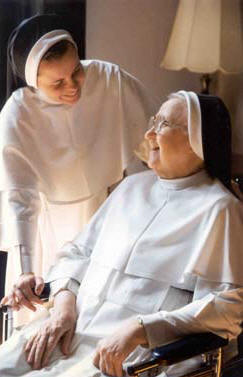
Vocation Spotlight: Dominican nuns in Michigan reaping the harvest of vocations


Clink the link below for a story that aired on NPR radio regarding the successful vocation "recruitment" of the Dominican Sisters of Mary, Mother of the Eucharist in Ann Arbor, MI.

http://www.npr.org/templates/story/story.php?
storyId=6903601


[The community's web site: http://www.sistersofmary.org/ ]

A recent Detroit newspaper article on the community:
http://www.detnews.com/apps/pbcs.dll/article?AID=/
20061226/LIFESTYLE04/612260371

Labels: , ,

Tuesday, January 16, 2007

The Shakers: an American take on an ancient tradition

Last week Iowa Public Television aired Ken Burns' documentary on the Shakers. I liked Ken Burns' series on the history of baseball so I was eager to see this short documentary.
From Wikipedia:

The Shakers, a Protestant religious denomination, originated in Manchester, England in 1772 under the leadership of Mother Ann Lee, who moved the 9-person group to the United States in 1774. They built 19 communal settlements that attracted over the next century some 200,000 converts. Strict believers in celibacy, Shakers maintained their numbers through conversion and adoption of orphans. Turnover was very high; the group reached maximum size of about 6,000 full members in 1850, and now has four members left. [1]

The Shakers (or, "shaking Quakers") were so named because of their peculiar rite of trembling, dancing, shaking, shouting, and speaking in tongues. I grew in my admiration for this group when I heard their testimony. Their founder and later members all had a great sincerity and desire to live out the Gospel in a radical way. They lived a life of simplicity. Their buildings and clothing were simple and austere. They considered their daily routine of work and craftsmanship as acts of prayer... and as such, they strove for beauty and perfection. They considered their vow of celibacy to be an attempt to live a life more perfectly configured to Jesus Christ (who was celibate). I wondered whether or not they had sound theological motives for their practice of celibacy (of course, some Christian sects in history have made celibacy mandatory for false reasons--such as the heresy that creation, the body and sexual intercourse were evil). One current day Shaker remarked that the Shaker way of celibacy was not for everyone... that some were called to motherhood and fatherhood... otherwise "there would be no more new Shakers!" It interested me to know that the Shaker view of celibacy seemed to match the Catholic understanding.

I was also impressed by what one Shaker woman said was the defining characteristic of the Shakers: the familial love that was expressed and felt. The Shakers took in orphans and adult seekers who felt called to the community. They even hinted at the fact that their celibate lives contributed to this ability to see every member as one's brother or sister.

People flocked to see and hear the strange "liturgy" of movement and the heavenly singing of the Shakers at worship. Once again, what struck me was how all of the Shakers and all of the historians spoke of this religious phenomenon as if it was the first such movement in the history of Christianity since the dawning of the apostolic age. Had they never heard of the long and rich history or men and women relgious movements in the Catholic Church? For centuries, Catholics had been living out the evangelical counsels of poverty, obedience, and chastity in a myriad of beautiful ways. Think of the austere life of the Cistercian monks... the Trappists. St. Benedict himself spoke of ora et labora (prayer and work)... and certainly, he considered daily work to be part of the "prayer without ceasing" which St. Paul called us to. Of course, we also see the call to sanctify the world through the holiness of ordinary work in St. Josemaria Escriva's Opus Dei movement. St. Therese of Lisieux--the little Flower--spoke of finding holiness in ordinary daily activities in her "little way." The list goes on and on.

One historian remarked that the genius of American Protestantism was that no one could tell someone else how to experience God (once again, the idolatry of anti-authoritarianism and individual freedom). There was a freedom to venture on such religious experiements such as the Shakers did. Of course, what few people apparently realize is that the road that the Shakers tread was blazed by the innumerable religious orders of the Catholic Church before them.

More on the Shakers:
http://www.pbs.org/wnet/ihas/icon/shakers.html
http://religiousmovements.lib.virginia.edu/nrms/Shakers.html
http://en.wikipedia.org/wiki/Shakers

Labels: ,

Tuesday, December 12, 2006

Vocation Spotlight: Is Priestly Celibacy BIBLICAL?

It has been a hot-button issue for some time now: should the Holy See waive the centuries old discipline of celibacy for those to be ordained as priests within the Latin Rite of the Catholic Church? Many bring this question up because they believe that it might encourage more men to step forward for priestly ordination and thus alleviating the current priest shortage that is dramatically effecting so many parishes in the United States.

There are many ways to tackle this issue. First, we should ask—is there any biblical evidence that celibacy is of any spiritual value?

Celibacy in the Bible (all citations from the NAB)

Isaiah 56:3-5: Let not the foreigner say, when he would join himself to the LORD, "The LORD will surely exclude me from his people"; Nor let the eunuch say, "See, I am a dry tree." For thus says the LORD: To the eunuchs who observe my sabbaths and choose what pleases me and hold fast to my covenant, I will give, in my house and within my walls, a monument and a name Better than sons and daughters; an eternal, imperishable name will I give them.

The New Jerome Biblical Commentary (a modern historical-critical commentary) has the following note for this verse: “Eunuchs: Such were refused admission “into the assembly of the Lord” (Lev. 22:24; Deut 23:2), because it seemed improper for a person, deprived of the power of transmitting life, to associate with the God of life. Some Israelites were castrated for working within the harem of Israelite or foreign kings (1 Sam 8:15; etc.). Trito-Isaiah urges their full readmission among God’s people (Wis. 3:14). Their contribution to Israel’s vibrant religious life will be their ‘monument and name,’…”

This same Commentary states that Isaiah 56 here gives the Old Testament background for Jesus’ key remark concerning celibacy “for the kingdom” as well as other important New Testament references to celibacy:

Matthew 19:9-12 (NAB): I say to you, whoever divorces his wife (unless the marriage is unlawful) and marries another commits adultery." [His] disciples said to him, "If that is the case of a man with his wife, it is better not to marry." He answered, "Not all can accept [this] word, but only those to whom that is granted. Some are incapable of marriage because they were born so; some, because they were made so by others; some, because they have renounced marriage for the sake of the kingdom of heaven. Whoever can accept this ought to accept it."

If celibacy were somehow against God’s will—why would the Son of God, God incarnate, live his earthly life as a celibate?

Some critics of the Church’s discipline will point to the fact that Peter (the first “Pope”!) was (gasp!) … married (citing references to Peter’s “mother-in-law”, Mark 1:30)! Perhaps they forget that Peter—speaking for all of the apostles—also makes a reference to an act of renunciation—the renunciation of possessions. In His reply, Jesus also relates the renunciation of a “wife” to the general call of abandonment for the Gospel (I include a few preceding verses for context):

Luke 18:29-30 (NAB): For it is easier for a camel to pass through the eye of a needle than for a rich person to enter the kingdom of God." Those who heard this said, "Then who can be saved?" And he said, "What is impossible for human beings is possible for God." Then Peter said, "We have given up our possessions and followed you." He said to them, "Amen, I say to you, there is no one who has given up house or wife or brothers or parents or children for the sake of the kingdom of God who will not receive (back) an overabundant return in this present age and eternal life in the age to come."

Even if Peter did not choose to leave his family in order to follow Jesus (he could have been a widower), still at some point, he had to make a break with wife and family in order to travel with Jesus, take upon the responsibility of the chief apostle, and eventually (as tradition tells us) be martyred.

Further on in Matthew 19 we learn that renunciation leads to a divine reward—including eternal life:

Matthew 19:27-30: Then Peter said to him in reply, "We have given up everything and followed you. What will there be for us?" Jesus said to them, "Amen, I say to you that you who have followed me, in the new age, when the Son of Man is seated on his throne of glory, will yourselves sit on twelve thrones, judging the twelve tribes of Israel.
And everyone who has given up houses or brothers or sisters or father or mother or children or lands for the sake of my name will receive a hundred times more, and will inherit eternal life.

And this seems to relate to the fact that we are called to place the supernatural love of Christ above the natural loves for family, etc.:

Matthew 10:37-38: "Whoever loves father or mother more than me is not worthy of me, and whoever loves son or daughter more than me is not worthy of me; and whoever does not take up his cross and follow after me is not worthy of me.

The beauty of virginity and celibacy is that it more perfectly anticipates what life will be like in heaven. In heaven, we will not “marry nor [be] given in marriage”. Why is that? Because marriage is a sacrament that is supposed to symbolize the union between Christ and the Church. It is a sacrament that is supposed to give a man and a woman the grace to be configured to Jesus Christ and grow in intimacy with God through their mutual love for one another and for their children. When we are before God in heaven… there will be no need for sacraments because we will be in the presence of God himself!:

Matthew 22:30: Now at the resurrection, of the seven, whose wife will she be? For they all had been married to her." Jesus said to them in reply, "You are misled because you do not know the scriptures or the power of God. At the resurrection they neither marry nor are given in marriage but are like the angels in heaven.

Other key passages in the New Testament related to celibacy:

Matthew 8:20-22: some disciples are called to follow Christ just as He tread the earth in ministry—with “nowhere to lay his head.”

And the great St. Paul—himself apparently a celibate—gives perhaps the most complete endorsement of celibacy as a prime way to serve the Kingdom:

1 Corinthians 7:17, 25-35: Only, everyone should live as the Lord has assigned, just as God called each one. I give this order in all the churches. … Now in regard to virgins, I have no commandment from the Lord, but I give my opinion as one who by the Lord's mercy is trustworthy. So this is what I think best because of the present distress: that it is a good thing for a person to remain as he is. Are you bound to a wife? Do not seek a separation. Are you free of a wife? Then do not look for a wife. If you marry, however, you do not sin, nor does an unmarried woman sin if she marries; but such people will experience affliction in their earthly life, and I would like to spare you that. I tell you, brothers, the time is running out. From now on, let those having wives act as not having them, those weeping as not weeping, those rejoicing as not rejoicing, those buying as not owning, those using the world as not using it fully. For the world in its present form is passing away. I should like you to be free of anxieties. An unmarried man is anxious about the things of the Lord, how he may please the Lord. But a married man is anxious about the things of the world, how he may please his wife, and he is divided. An unmarried woman or a virgin is anxious about the things of the Lord, so that she may be holy in both body and spirit. A married woman, on the other hand, is anxious about the things of the world, how she may please her husband. I am telling you this for your own benefit, not to impose a restraint upon you, but for the sake of propriety and adherence to the Lord without distraction.

In short, celibacy is not natural—rather, it is “supernatural.” To live a life of consecrated celibacy is to live a life in imitation of Jesus, a life which requires reliance upon God’s grace. Celibacy is the offering of something good—marriage—to God as a gift… an act of renunciation so that a man can serve the kingdom in a unique and demanding way… and also so that he can attain a certain intimate union with Christ. Celibacy in no way denigrates marriage.

Holy matrimony is also a demanding and beautiful sacrament. The Church, in her wisdom, has determined that the norm for the Latin rite is that only celibate men would be ordained to the priesthood. There are exceptions of course: married clergymen who convert from the Anglican or Lutheran communities have been admitted to holy orders in some cases. I have known a few of such priests and they are outstanding! However, the wisdom of the Church has seen that the discipline of mandatory celibacy as the norm better serves the needs of the Church.

This is a discipline—not a doctrine. It could be changed. However, a change does not seem imminent at this time. We must also question what difference such a change would make in the pastoral ministry of priests and also the number of priestly ordinations. For my part, I will continue to trust Holy Mother Church. She knows best!

Links

For more apologetic articles defending priestly celibacy (including answers to objections that some anti-Catholics find in the Bible [Gen 1:28; 1 Cor 7:2; 1 Tim 3:2, 4-5) see the following link:
http://www.catholic.com/library/Celibacy_and_the_Priesthood.asp

An article from Fr. Cantalamessa, preacher to the papal household, “Virginity, a Positive Approach to Celibacy”:
http://www.wf-f.org/03-4-Virginity.html

For coverage of the sad Archbishop Milingo affair [the recently excommunicated Archbishop of the Zambian capital of Lusaka who has been ordaining married men to the priesthood], see:
http://www.catholicnewsagency.com/new.php?n=8246

http://www.catholicnewsagency.com/new.php?n=7693

http://fatherjoe.wordpress.com/2006/07/13/archbishop-milingo-schism-over-married-priests/

Labels: , , ,

Thursday, August 10, 2006

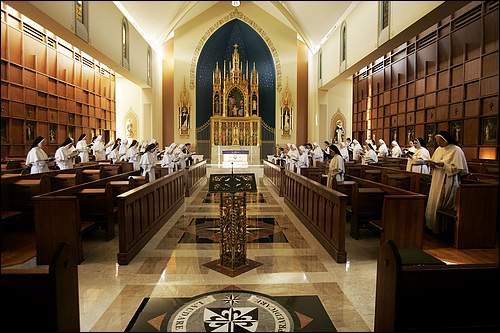
Where have all the monks and nuns gone?


Where have all of the monks and nuns gone?

It is obvious to everyone that there has been a notable decline in the numbers of men and women religious in the United States.

Here are some stats for the U.S.: Women religious (sisters and nuns) have been hit the hardest: They have gone from 122,159 in 1945 (or 1 woman religious per 180 Catholics)to 79,876 in 2000 (or 1 woman religious per 761 total Catholics). That is a decline of 54%. The median age of women religious has gone from around 62-63 in 1985 to the mid-upper 60's in 2000.

Religious priests (priests who are in a religious order, not diocesan parish priests) have gone down 30% in the same time period, and Religious brothers (those who are in a religious community but are not ordained to the priesthood) are down 36%. The median age of the men has gone from 55 in 1985 to 62 in 2000. [These stats are according to Georgetown's Center for Applied Research in the Apostolate: http://cara.georgetown.edu/bulletin/RelStatistics.html ]

(kinda depressing, huh?)

Monks, nuns, friars, and sisters used to have a very visible presence and are part of a cherished memory especially for many older Catholics who attended parochial schools. Indeed men and women religious have made a tremendous contribution to the history of the Church and this nation. They possess a legacy of education, charitable service, and prayerful ministry that we have too easily taken for granted and trivialize (say “nun”, and we automatically summon ruler-slapping-hand jokes).

Well, where have they all gone? Yes it is true that the number of consecrated religious (men and women who have consecrated themselves to God via vows of poverty, obedience, and chastity) in the U.S. are down. But is there extinction a foregone conclusion? Are we facing the death of a once beautiful way of life in the Church? Is religious life no longer relevant in our modern world? (... Not a chance, keep reading...)

Contrary to what a lot of Catholics hear and see, there are a few orders that are quietly reviving and growing. Many of these orders are reforms of traditional orders (Franciscan, etc.). Some of these communities are growing VERY FAST... with young men and women entering at such a rate that the communities cannot accept everyone that wants to enter right away. Below is a list of links to some of these groups that I know of (and there are no doubt more)... some of which I have had the great privilege of visiting.

BEFORE THOSE LINKS, however, CHECK OUT THE FOLLOWING. It is a newsletter put out by the Franciscan Friars of the Renewal (CFR). They are a new reform order founded on the Capuchin Franciscan tradition (one famous Capuchin was St. [Padre] Pio) by Fr. Benedict Groeschel and some others. You may know of Fr. Groeschel from his shows on EWTN and his many outstanding books. This group of friars live in various areas of New York city and work with the very poor. They are dedicated to serving the poor and evangelization. The friaries where they live are simple, they sleep on the floor in sparce cells, they have no TV, they eat simply and pray often... they also are down to earth men who laugh and have a great time as a community. The friars average 15-20 new men a year! Soon they will have to start spreading to other cities in NY. (There is also a small group of sisters). This newsletter article gives a lot of information about religious vows. Check it out:

http://www.franciscanfriars.com/fr.%20glenn%20letters/frglenn797.htm

[Also, FYI, there main web site is: http://www.franciscanfriars.com/ ]
_____________________________
Other interesting religious orders (these are just some, check out those links that sound interesting...):

WOMEN RELIGIOUS

The Dominican Sisters of St. Cecilia Congregation – Nashville, TN
http://www.nashvilledominican.org/

The Dominican Sisters of Mary Mother of the Eucharist (Ann Arbor, MI)
http://www.sistersofmary.org/

Sisters of Life – NY
http://www.sistersoflife.org/

Sisters of St. Francis of the Martyr St. George – Alton, IL.
http://www.altonfranciscans.org/

Carmel of St. Theresa of Alhambra, CA (Carmelites)
http://members.aol.com/teresacarm/

Poor Clares of Perpetual Adoration (PCPA) (Mother Angelica, EWTN)
http://www.olamshrine.com/olam/nuns.htm

Missionaries of Charity (of course) (Blessed Mother Theresa)
http://www.cmswr.org/member_communities/MC.htm

MEN RELIGIOUS

The Congregation of the Missionaries of the Immaculate Conception
http://www.marian.org/ (promoters of the Divine Mercy devotion, etc.)

Franciscan Friars of the Eternal Word (MFVA, Mother Angelica, EWTN)
http://www.mfva.info/mfva/default.asp

Franciscan Brothers of Peace
http://www.brothersofpeace.org/

Little Brothers of St. Francis
http://www.littlebrothersofstfrancis.org/

Franciscans of the Immaculate (reform from the Convetual Franciscan tradition)
http://www.marymediatrix.com/rel_life/

St. Michael's Abbey of the Norbertine Fathers
http://www.abbeynews.net/

St. Louis Abbey (Benedictine)
http://www.stlouisabbey.org/

Oratory of St. Philip Neri
http://www.oratory-toronto.org/

Priestly Fraternity of St. Peter
http://www.fssp.com/

Fathers of Mercy
http://www.fathersofmercy.com/

A good general website for information on religious communities:
http://religiouslife.com/ Institute on Religious Life

LET'S ALL CONTINUE TO PRAY FOR VOCATIONS (and there will be more on that topic later...) (in the meantime, get to praying! ...)

PRAYER FOR VOCATIONS
Lord Jesus Christ, shepherd of souls, who called the apostles to be fishers of men, raise up new apostles in your holy Church. Teach them that to serve you is to reign: to possess you is to possess all things. Kindle in the hearts of our young people the fire of zeal for souls. Make them eager to spread your Kingdom upon earth. Grant them courage to follow you, who are the Way, the Truth, and the Life; who live and reign for ever and ever. Amen.

Labels: , ,