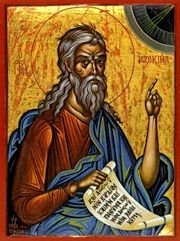
SWALLOWED SCROLL: Scripture, Tradition, Catechesis, Evangelization
"Eat this scroll, then go, speak to the house of Israel" Ezekiel 3:1
Friday, March 21, 2008
Behold the Man

This came as an email from www.CatholicMenResources.org by Peter Herbeck
Hopefully you will be receiving this email on Good Friday. In your prayer today, or as you attend the Good Friday liturgy, ask the Holy Spirit to allow you to hear and receive Jesus’ words to you from the cross. As you gaze upon him, let him speak to you. He wants to tell each one of us in this Men’s Movement what it means to be a man, to be God’s man.
Jesus is the truth about you and me. Never is that truth more eloquently communicated than from the cross. On the cross he bears our grief, our shame, the isolation and the ultimate judgment that sin, our sin, has produced. He took my place, bore my punishment, and took my destiny upon his shoulders. He shows us our end, where our lives were headed, what we deserved, and in that act, he is telling us the truth about what our attachment to sin has produced.
Holy Thursday 2008
Wednesday, March 19, 2008
Archbishop Hanus Reflects on Hope at Chrism Mass

Last November, Pope Benedict XVI published his second encyclical: Spe Salvi. It deals with Christian hope.
I began studying it and using it for meditation in the month of December. At the same time, I was also very much preoccupied with my ninety-eight-year-old mother, who was getting weaker by the day. I visited her several times last year, and we would talk about her approaching death and her hope for eternal life.
One section of Pope Benedict’s new encyclical has the title "Eternal life–what is it?" The Holy Father asks the question, "Is the Christian faith also for us today a life-changing and a life- sustaining hope?" (10).
Certainly it was for my mother. Her life and her dying would not have made sense without her faith.
The Pope invites us to think about when it all starts for us Christians. He paints the scene of parents bringing their child to be baptized. He makes use of the classic form of infant baptism found in the Roman Ritual for centuries. The priest first of all asks the parents what name they had chosen for their child. Then he continues with the question, "What do you ask of the Church?" The parents answer, "Faith." Then comes the next question, "What does faith bring you?" And the parents answer, "Eternal life."
Our faith is the key to eternal life. Mom was able to live the kind of life she did because of the gift of faith which she received at baptism. She was able to endure with dignity the sufferings and hardships of life, especially the pain and sufferings of her last years, because she had a great hope in eternal life.
So the Pope makes this initial point in his encyclical: because we believe, we hope.
Certainly that is the experience of many. Human life, because of sin, because of illness and tragedies, because it is often full of sorrow and suffering, can become almost unbearable.
The Holy Father is touching on the very heart of our human existence. "On the one hand, we do not want to die; above all, those who love us do not want us to die. Yet on the other hand, neither do we want to continue living indefinitely . . . " (11).
Up to this point in her life, the only masters she knew were those who had abused and enslaved her. Now she learned that there was a Master, a divine Master, who didn’t hurt people. Rather, this divine Master was kind and good, goodness in person. This Master had created her, loved her now, cared about her, and was inviting her to a life that was completely different than what she had experienced. "What is more, this master had himself accepted the destiny of being flogged and now he was waiting for her ‘at the Father’s right hand.’ Now she had ‘hope’ – no longer the modest hope of finding masters who would be less cruel, but the great hope: [Listen to what she later wrote in her memoirs] ‘I am definitively loved and whatever happens to me – I am awaited by this Love. And so my life is good’" (3).
Jesus showed her that there is a God, One who is not an indifferent, distant being, unconcerned about us. God rather is a Person who loves us, creates us, sustains us, and comforts us. Jesus showed her how to live, how to hope, and how to die.
He will become a member of this presbyterate, joining his energies to those of his brother priests, who work so hard to be faithful ministers of Christ the High Priest, leading the people to Jesus the fountain of their salvation (cf. Prayer of the assembly for the priests in the Chrism Mass).
The Spirit of the Lord came upon you. You were anointed, so that through you the Lord Jesus could heal the brokenhearted, proclaim liberty to captives, and give the people oil of gladness in place of mourning. May Christ continue to strengthen you, to bring to completion the good work he has begun in you (Ordination rite).
Labels: Holy Week, Lent, priesthood, saints
Tuesday, February 26, 2008
Stations of the Cross for children: a sampling
I was surfing the net for some Stations of the Cross for children, and thought I would posts some links to a few I found. I also printed these out and have them available at the office:
-Large size colorable pages of the stations (just the images and the station titles, no description texts or prayers). I like this one best. I will print these out on cardstock so that we have a "portable" stations set that we can hang up in the daily mass chapel when requested (or, you can have a set printed out for your room--just ask, and we will make the copies:
http://www.catecheticalresources.com/
attachment.cfm?Attachment=ACF2600.pdf
-From CatholicMom.com another set of colorable stations, though these images are smaller than the ones found at the link above (also a little more carto0nish):
http://www.christiancoloring.com/cmpdf2006/
stations/stations_booklet.pdf
-from DomesticChurch.com:
http://www.domestic-church.com/CONTENT.DCC/
20040101.GRAPHICS/stations3b.pdf
-a stations for children, the images are not much, but there is a description text that you can check out. Also, a decent introduction to the Stations (explaining the meaning of a "station" etc.):
http://www.cptryon.org/prayer/child/stations/index.html
-a printer-friendly text for the stations:
http://www.creighton.edu/CollaborativeMinistry/stations-prn.html
-A traditional stations of the Cross booklet from the 1930's, short, with beautiful color pictures. Can be printed out as one-sided sheets, or as two-sided booklet form:
http://familyfeastandferia.wordpress.com/
stations-of-the-cross-for-children/
Labels: Lent, prayer, resources for catechists, youth
Monday, February 11, 2008
25 things you can do for Lent

…besides giving up chocolate
Compiled by Renée LaReau
Ash Wednesday marks the beginning of Lent, the 40 days of preparation for the Easter season when Christians are called to renew their commitments to spiritual practices like prayer, fasting and almsgiving. Lent is an annual opportunity to grow in our faith, which means it’s about much more than giving up unhealthy foods or treats, as you may have done when you were a kid. It is about abstaining from whatever is unhealthy in our lives—gossip, laziness, lack of social conscience—and, most importantly, taking concrete steps to do something more. Challenge yourself this year, and go beyond the clichés of “giving up” something. Now is a great time to take stock of your spiritual life, and to grow in it. Not sure where to start? Check out these 25 ideas:
Want to hear more on what Lent’s all about? Listen to/read “What is Lent” by Fr. Greg Friedman, OFM
1) Make a commitment to reading the Sunday readings before you go to Mass. In the same way that reading up on football players, opposing teams, and coaching strategies will help you experience a game more fully, familiarizing yourself with the readings ahead of time can allow you to experience them in a deeper way on Sunday. (Find the Sunday readings here).
2) Don’t have time to read all three readings? Then just read the Gospel.
3) Make a commitment to trying something new spiritually. Never tried an hour of Eucharistic adoration? Find a parish where you can try it. Never attended Mass at a parish of an ethnic group that’s different than yours? Give it a try.
4) Think about what you usually spend your money on. Do you buy a few too many clothes? Spend a few too many bucks on iTunes? Eating out? Pick one type of expenditure that you’ll “fast” from during Lent, and give the money you would usually spend to a great local charity.
Challenge yourself this year, and go beyond the clichés of “giving up” something. Now
is a great time to take stock of your spiritual life, and to grow in it.
5)When you first sit down in front of your computer at work, or at the very end of your work day, try a great 10-minute prayer, based on the spiritual exercises of St. Ignatius, at Sacred Space brought to you by the Irish Province Jesuits.
Renée LaReau is a Contributing Editor for BustedHalo.com. She writes from Columbus, Ohio.
Comments to: editor@bustedhalo.com
Labels: Lent, spirituality
Wednesday, February 06, 2008
Tuesday, January 22, 2008
Gearin' up for Lent
Lent is not too far away, so I am going to start posting some links to resources that might be helpful in teaching and living the season of Lent:
Jimmy Akin:
http://www.jimmyakin.org/2005/02/annual_lent_fig.html
Marcellino D'Ambrosio:
http://www.crossroadsinitiative.com/library_category
/3/Lent_and_Holy_Week_Resources.html
ChurchYear.net has a lot of interesting pages:
http://www.churchyear.net/lent.html Lent history, information, prayers, resources, traditions & more
http://www.churchyear.net/lentprayers.html Good prayers for Lent
http://www.churchyear.net/lentfast.html Suggestions for your Lenten fast
http://www.churchyear.net/lentcanticles.html Lent hymns and canticles
Domestic Church:
http://www.domestic-church.com/CONTENT.DCC/
9980301/FRIDGE/EXPL_LENT.HTM Exploring Lent, Domestic-Church.com
http://www.domestic-church.com/CONTENT.DCC/
20020301/FRIDGE/lent_activity.htm Lent for Little Ones
http://www.domestic-church.com/CONTENT.DCC/
19990301/ARTICLES/fastrules.htm Guidelines for fasting, abstinence, and self-denial in Lent
Readings and Meditations for Lent & Holy Week:
http://www.rc.net/wcc/readings/lent.htm
http://www.victoriadiocese.org/catechetical/
journey_files/journey.htm Disciples on the Journey--a 34 page Lenten lectionary based faith-sharing booklet for adult, family, and teen groups (I just saw an advertisement of this, have not previewed it, don't know if it is any good).
http://www.franciscanradio.org/Retreats/Lent/default.asp Lenten Radio Retreat
...MORE TO BE ADDED LATER...
Labels: Lent, resources for catechists
Spend 40 Days with the Fathers
I found this little nugget on www.churchyear.net . It is a Church Fathers Lenten reading plan (texts included). It is a long pdf document, but well worth printing out. This would provide a good introduction to the early Church fathers for the neophyte... and good sound spiritual reading for the ones who have read these before...
http://www.churchyear.net/lentfatherscomplete.pdf
Labels: Church Fathers, Lent, religious history, spirituality
Thursday, December 13, 2007
It is ROSE, don't call it "pink"! (Gaudete Sunday)

http://www.catholicexchange.com/node/68068
Br. Hyacinth Marie Cordell, OP
Why “Gaudete?”
December 13, 2007
Violet is the liturgical color of Lent and Advent. Yet, in both holy seasons, over half way through, we discover the bright color of rose in the liturgy... but only for one Sunday.[i] The Sunday in Lent is called Laetare Sunday, in Advent Gaudete Sunday. Both these Latin words (Gaudete and Laetare, from the Entrance Antiphons at Mass) are translated, "Rejoice!" But why the color rose, and why "rejoice"?
The Meaning of Rose
To understand the meaning of rose, we first need to be aware of a certain liturgical principle, here expressed in the words of Dr. Pius Parsch:
"Nature's annual cycle is characterized by two phenomena, light and life. Out of the darkness of night comes light; out of death comes life. The transition from night to light characterizes the winter season; the transition from death to life is proper to summertime. The holy year of the Church is likewise divided into two phases which have similar characteristics."[ii]
In other words, nature and the mysteries of our salvation coincide. The dark color of violet in Advent harmonizes well with the diminishing sunlight late in the year, and in Lent with the silence of life through Winter leading up to Spring. In both cases, we see a parallel. Just as darkness gives place to light at the turn of the Winter Solstice and death to life at the beginning of Spring, so the violet of Advent gives place to the bright white of Christmas joy, and of Lent to the brightness of Easter life. "But wouldn't black be more appropriate as a color of darkness and death?" someone might wonder. Ah, here again we encounter the Church's wisdom! Black is the absence of all color and light. But as "children of the light," we are never in complete darkness. "The light shines in the darkness, and the darkness has not overcome it."[iii] Even in funeral liturgies where priests can wear black as a symbol of mourning, the liturgy speaks of light: "let perpetual light shine upon them." Violet is a dark and penitential color, but it is also the ancient color for royalty and wealth. Through baptism, we have been immersed in Light and Life, and we have been given the royalty of being children of the King of Heaven! So, violet expresses well both these aspects: darkness and royalty.
With this dramatic backdrop, we can understand the rose color of Gaudete and Laetare Sundays and the hidden lesson contained here for us. Rose is a softening of violet. It is violet approaching white. In this sense, it anticipates the pure white of the Birth and Resurrection of Christ. It intimates the mystery of the "already, and not yet" of Christian life. The Messiah has come. We have been redeemed. We have been washed. We have been sanctified. The Light that is God has come to dwell in our souls. The Father "has delivered us from the dominion of darkness and transferred us to the kingdom of his beloved Son, in whom we have redemption, the forgiveness of sins."[iv] And yet, we wait for Christ to come. We wait for eternal life. We wait for "the redemption of our bodies."[v] We are still in a "valley of tears." "For now we see in a mirror dimly, but then face to face."[vi]
But even in the night of this life, this expectancy fills us with joy. Gaudete and Laetare Sundays express the foretaste of the good things to come that we experience even now. The Church summons us to "look up and raise your heads, because your redemption is drawing near."[vii] In this sense, Laetare Sunday is like an oasis in the desert of Lent, and Gaudete Sunday like the appearance of the first streaks of dawn in the night of Advent. It is as if we were sentinels keeping watch at night, longing for the sun to appear, being buoyed up with joy at the first streaks of light. With the words of Psalm 130, we pray, "My soul waits for the Lord more than sentinels wait for the dawn."[viii] And with the prophet Habakkuk, we resolve: "I will take my stand to watch, and station myself on the tower, and look forth to see what he will say to me."[ix]
The Expectation
So, what are we waiting for? We are waiting for the One who said, "I am the light of the world; he who follows me will not walk in darkness, but will have the light of life."[x] St. Bernard of Clairvaux explains that, "We know that there are three comings of the Lord. The third lies between the other two. It is invisible, while the other two are visible... In his first coming our Lord came in our flesh and in our weakness; in this middle coming he comes in spirit and in power; in the final coming he will be seen in glory and majesty."[xi]
In Advent we, in a sense, wait with expectation and joy for all three. We place ourselves along the prophets of old as they waited for the coming Messiah. We do this mystically in order to comprehend more profoundly what a difference Christ's coming has made. We also wait in the darkness of this life for the coming of the Son of man "with the clouds of heaven."[xii] That is, we rekindle our longing for the Second Coming and the completion of our life's journey toward God. And finally, we wait for the coming of Christ more deeply into our life now, in preparation for the last coming. St. Bernard explains that this middle coming is the road from the first to the final coming of our Savior.
Advent is a time consecrated to this road. The nearness of the Lord's coming is announced to us at the beginning of Advent in the words, "Our Savior is coming."[xiii] It is made even more imminent during Gaudete Sunday when the announcement is changed to, "The Lord is near."[xiv] Just as the color rose approaches white, so in the middle of Advent we approach the Lord with joy. We are closer than ever before: "For salvation is nearer to us now than when we first believed."[xv] And here is the point: we rejoice not only in the future coming of the Lord; we rejoice now as we have the opportunity to let Christ penetrate more deeply into our hearts. In Advent, the Holy Spirit wishes to open the doors of our hearts more fully to the Savior of our souls: "Lift up your heads, O gates! And be lifted up, O ancient doors! That the King of glory may come in."[xvi] For, "the path of the righteous is like the light of dawn, which shines brighter and brighter until full day." "And we all, with unveiled face, beholding the glory of the Lord, are being changed into his likeness from one degree of glory to another; for this comes from the Lord who is the Spirit."[xvii] Nothing matters more in life than that we grow in the divine light of love that is in Christ. And nothing can give us greater joy.
Joy, Fortitude, and Patience
Holy Mother Church knows that it is easy for us to get distracted by "the cares of the world,"[xviii] and overly sorrowful due to the trials of life. That is why she rouses us to joy in the Entrance Antiphon of Gaudete Sunday, which comes from Paul's letter to the Philippians: "Rejoice in the Lord always; again I say, rejoice! The Lord is near." This text in Scripture continues: "Have no anxiety at all, but in everything, by prayer and petition, with thanksgiving, make your requests known to God. And the peace of God that passes all understanding will guard your hearts and minds in Christ Jesus."
We can all reflect: in what ways am I overly anxious about the cares of life? In what ways have I let despair and self-pity conquer my hope? Jesus revealed the ways of the kingdom to us in his words, so that, as He said, "my joy may be in you, and that your joy may be full." As He approached the Passion and Resurrection, He also said, "So you have sorrow now, but I will see you again and your hearts will rejoice, and no one will take your joy from you."[xix] Even further, He reassures us: "In the world you have tribulation; but be of good cheer, I have overcome the world."[xx] Gaudete Sunday is an opportune time to examine how free we are to embrace the joy of the Lord's coming into our lives more completely.
But where will we find strength to embrace this joy? In the Mass Readings for Gaudete Sunday this year, two virtues in particular are extolled for us to possess the Lord's joy more fully. In the first reading, Isaiah urges us on to fortitude: "Strengthen the hands that are feeble, make firm the knees that are weak... Be strong, fear not!" In the second reading, St. James exhorts us to patience: "Be patient... until the coming of the Lord."
Both virtues serve us in time of trial. Trials over time have a way of making us apathetic, complacent, and discouraged. Exercising the virtue of fortitude gives us the strength to endure times of pain, loss, sadness, and strain in relationships. And when the distress seems overwhelming and too much for human strength, the Holy Spirit provides us with the gift of fortitude to "go forward,"[xxi] so that we can know with St. Paul: "for when I am weak, then I am strong."[xxii] Patience, in turn, can be thought of as "fortitude over time." St. James insightfully associates patience with waiting through hardships. This waiting involves letting go of trying to control what is beyond our control. It also involves joyfully accepting these elements as within the will of God, which is always for our good in the end.
Fortitude and patience together are antidotes against apathy and anxiety. They enable us to have joy in the cross. We don't have the ability to give ourselves these graced virtues. But just as in the Gospel the Messiah is identified precisely as the One who can open the eyes of the blind and cleanse lepers, so He is the One Who can heal our own complacency and impatience and give us the strength to wait for Him in times of trial. In this fashion, the Lord heals us of our despondency and opens up to us the joy of His advent.
As the darkness augments at the close of this year, we know the light will prevail. Christ has come. And Christ is coming. With joy, fortitude, and patience, we keep watch for the approaching light. In rose vestments and with the rose candle of the Advent wreath, we rejoice in anticipation of the Day of our Redemption. What are we anxious about? St. Peter exhorts us, "Cast all your anxieties on him, for he cares about you. Be sober, be watchful."[xxiii] Let us cast them thus, so that the "Dawn from on High will break upon us"[xxiv] and saturate our hearts more completely. Holy Mary, Mother of God, pray for us. Help us to receive Him. Maranatha! "Come Lord Jesus!"[xxv]
[i] The color rose is popularly but incorrectly thought of as pink.
[ii] Parsch, Dr. Pius. The Church's Year of Grace. Collegeville, Minnesota: The Liturgical Press, 1962: p.169
[iii] Jn 1:5 (All Bible translations are from the following unless stated: The Holy Bible: RSVCE. 1st Edition. San Francisco: Ignatius Press)
[iv] Col 1:13-14
[v] Rom 8:23
[vi] 1 Cor 13:12
[vii] Lk 21:20
[viii] Ps 130:6 (Translation used during the daily Dominican prayers for the dead)
[ix] Hab 2:1
[x] Jn 8:12
[xi] Liturgy of the Hours. Vol. 1. New York: Catholic Book Publishing Co.: p. 169
[xii] Dan 7:13
[xiii] From the Entrance Antiphon of Monday of the First Week of Advent.
[xiv] From the Entrance Antiphon of the 3rd Sunday of Advent.
[xv] Rom 13:11
[xvi] Ps 24:7
[xvii] 2 Cor 3:18
[xviii] Mt 13:22
[xix] Jn 16:22
[xx] Jn 16:33
[xxi] Ex 14:15
[xxii] 1 Cor 12:10
[xxiii] 1 Pt 5:7
[xxiv] Lk 1:78 (Translation is from The Liturgy of the Hours)
[xxv] Rev 22:20
Br. Hyacinth Marie Cordell, OP is a Dominican Friar in formation for the priesthood at the Dominican House of Studies in Washington, D.C. Please visit our vocations blog at www.dominicanfriars.org.
Labels: Advent - Christmas, Lent, Liturgy
Saturday, April 07, 2007
"He Descended into Hell": Pope Benedict XVI on the Holy Saturday Mystery
The following is a beautiful passage from Introduction to Christianity by Joseph Cardinal Ratzinger (now Pope Benedict XVI) [1968, pp. 294-97]. Cardinal Ratzinger is dealing with an article of the Creed that causes a great deal of curiosity and confusion to the modern mind: Christ "descended into hell".
"...Instead of pushing the question aside, then, should we not learn to see that this article of faith, which liturgically is associated with Holy Saturday in the Church's year, is particularly close to our day and is to a particular degree the experience of our [twentieth] century? On Good Friday our gaze remains fixed on the crucified Christ, but Holy Saturday is the day of the "death of God", the day that expresses the unparalleled experience of our age, anticipating the fact that God is simply absent, that the grave hides him, that he no longer awakes, no longer speaks, so that one no longer needs to gainsay him but can simply overlook him. "God is dead and we have killed him." This saying of Nietzsche's belongs linguistaically to the tradition of Christian Passiontide piety; it expresses the content of Holy Saturday, "descended into hell" (cites: Cf. H. de Lubac, The Drama of Atheist Humanism).
_________________________
This article of the Creed always reminds me of two scenes in the Bible. the first is that cruel story in the Old Testament in wihch Elijah challenges the priests of Baal to implore their God to give them fire for their sacrifice. They do so, and naturally nothing happens. He ridicules them, just as the "enlightened rationalist" ridicules the pious person and finds him laughable when nothing happens in response to his prayers. Elijah calls out to the priests that perhaps they had not prayed loud enough: "Cry aloud, for he [Baal] is a god; either he is musing, or has gone aside, or he is on a journey, or perhaps he is asleep and must be awakened" (1 Kings 18:27). When one reads today this mockery of the devotees of Baal, one can begin to feel uncomfortable; one can get the feeling that we have now arrived in that situation and that the mockery must now fall on us. No calling seems to be able to awaken God. The rationalist seems entitled to say to us, "Pray louder, perhaps your God will then wake up." "Descended into hell"; how true this is of our time, the descent of God into muteness, into the dark silence of the absent.
__________________
But alongside the story of Elijah and its New Testament analogue, the story of the Lord sleeping in the midst of the storm on the lake (Mk 4:35-41, par.), we must put the Emmaus story (Lk 24:13-35). The disturbed disciples are talking of the death of their hope. To them, something like the death of God has happened: the point at which God finally seemed to have spoken has disappeared. The One sent by God is dead, and so there is a complete void. Nothing replies any more. But while they are there speaking of the death of their hope and can no longer see God, they do not notice that this very hope stands alive in their midst; that "God", or rather the image they had formed of his promise, had to die so that he could live on a larger scale. The image they had formed of God, and into which they sought to compress him, had to be destroyed, so that over the ruins of the demolished house, as it were, they could see the sky again and him who remains the infinitely greater. ...
____________________
Thus the article about the Lord's descent into hell reminds us that not only God's speech but also his silence is part of the Christian revelation. God is not only the comprehensible word that comes to us; he is also the silent, inaccessible, uncomprehended, and incomprehensible ground that eludes us. To be sure, in Christianity there is a primacy of the logos, of the word, over silence; God has spoken. God is word. But this does not entitle us to forget the truth of God's abiding concealment. Only when we have experienced him as silence may we hope to hear his speech, too, which proceeds in silence (in a footnote, Ratzinger notes the significance of silence in the writings of apostolic father Igantius of Antioch). Christology reaches out beyond the Cross, the moment when the divine love is tangible, into the death, the silence and the eclipse of God. Can we wonder that the Church and the life of the individual are led again into this hour of silence, into the forgotten and almost discarded article, "Descended ino hell"?
______________________
When one ponders this, the question of the "scriptural evidence" solves itself; at any rate in Jesus' death cry, "My God, my God, why have you forsaken me? (Mk 15:34), the mystery of Jesus' descent into hell is illuminated as if in a glaring flash of lightening on a dark night. We must not forget that these words of the crucified Christ are the opening line of one of Israel's prayers (Ps 22:1), which summarizes in a shattering way the needs and hopes of this people chosen by God and apparently at the moment so utterly abandoned by him. This prayer that rises from the sheer misery of God's seeming eclipse ends in praises of God's greatness. This element, too, is present in Jesus' death cry, which has been recently described by Ernst Kasemann as a prayer sent up from hell, as the raising of a standard, the first commandment, in the wilderness of God's apparent absence: "The Son still holds on to faith when faith seems to have become meaningless and the earthly reality proclaims absent the God of whom the first thief and the mocking crowd speak--not for nothing. His cry is not for life and survival, not for himself, but for his Father. His cry stands against the reality of the whole world." After this, do we still need to ask what worship must be done in our hour of darkness? Can it be anything else but the cry from the depths in company with the Lord who "has descended into hell" and who has established the nearness of God in the midst of abandonment by God?"
____________________________
...In this last prayer of Jesus, as in the scene on the Mount of Olives, what appears as the innermost heart of his Passion is not any physical pain but radical loneliness, complete abandonment. But in the last analysis what comes to light here is simply the abyss of loneliness of man in general, of man who is alone in his innermost being. This loneliness, which is usually thickly overlaid but is nevertheless the true situation of man, is at the same time in fundamental contradiction with the nature of man, who cannot exist alone; he needs company...
_____________________________
...where man falls into extreme loneliness he is not afraid of anything definite that could be explained away; on the contrary, he experiences the fear of loneliness, the uneasiness and vulnerability of his own nature, something that cannot be overcome by rational means. ...
___________________________
...The fear peculiar to man [fear of loneliness] cannot be overcome by reason but only by the presence of someone who loves him...
___________________________
...if a state of abandoment were to arise that was so deep that no "You" could reach into it any more, then we should have real, total loneliness and dreadfulness, what theology calls "hell". We can now define exactly what this word means: it denotes a loneliness that the word love can no longer penetrate and that therefore indicates the exposed nature of existence in itself. In this connection who can fail to remember that writers and philosophers of our time take the view that basically all encounters between human beings remain superficial, that no man has access to the real depths of another (i.e. the anthropolgy of Sarte)?...
_________________________
In truth--one thing is certain: there exists a night into whose solitude no voice reaches; there is a door through which we can only walk alone--the door of death. In the last analysis all the fear in the world is fear of this loneliness. From this point of view, it is possible to understand why the Old Testament has only one word for hell and death, the word sheol; it regards them as ultimately identical. Death is absolute loneliness. But the loneliness into which love can no longer advance is--hell.
_________________________
Labels: books, Holy Week, Lent, Sacred Scripture
The Dark Silence of Holy Saturday
Catholic Apologetics of America has posted a meditation from the book Divine Intimacy by By Fr. Gabriel of St. Mary Magdalen, O.C.D. :http://catholicapologeticsofamerica.
blogspot.com/2007/04/victory-of-cross.html
Labels: Holy Week, Lent, Sacred Scripture
Friday, April 06, 2007
A Good Friday Prayer

Labels: Holy Week, Lent, spirituality
Good Friday Fare
www.crossroadsinitiative.com/library_article
/916/Cosmic_Tree_Pseudo_Chrysostom.html
visualizza.phtml?sid=68364
Labels: Holy See (Vatican), Holy Week, Lent, spirituality
Thursday, April 05, 2007
Celebrating Holy Thursday
Labels: Holy Week, Lent, priesthood, vocations
Sunday, April 01, 2007
Holy Week and Lent recap
UPDATE: News & Current Events:
Holy Week amidst war and car bombings--an interesting post from Amy Welborn's blog:
http://amywelborn.typepad.com/
openbook/2007/04/holy_week.html
Audiences and Sermons of the Holy Father Pope Benedict XVI during Lent:
http://www.vatican.va/liturgical_year/lent/
ndex-lent2007-hf_en.htm
Music for Lent:
http://www.vatican.va/liturgical_year/lent/
index-lent2007-music_en.htm
Holy See's page for Holy Week:
http://www.vatican.va/liturgical_year/
holy-week/2007/index_en.htm
The Pope always has excellent Stations of the Cross texts (2006's was wonderful). This year, the meditations that Pope Benedict XVI will lead were composed by Msgr. Gianfranco Ravasi, the Prefect of the Ambrosian Library and Gallery of Milan:
Presentation:
http://www.vatican.va/news_services/liturgy/2007/
documents/ns_lit_doc_20070406_
via-crucis-present_en.html
and the Meditations:
http://www.vatican.va/news_services/liturgy/2007/
documents/ns_lit_doc_20070406_via-crucis_en.html
[famous 19th century Catholic convert scholar John Henry Newman's Stations of the Cross meditations (longer version):
http://www.newmanreader.org/works/
meditations/meditations5.html
(shorter version):
http://www.newmanreader.org/works/
meditations/meditations5.html#stations ]
(in handy PDF format):
http://www.doxaweb.com/assets/stations.pdf
[Podcast alley has a March 3 2007 posting of an audio mp3 file of the Stations of the Cross based on the film "The Passion of the Christ":
http://www.podcastalley.com/podcast
_details.php?pod_id=10006 ]
[PhatCatholic Apologetics posts a lot of info on the Stations of the Cross:
http://phatcatholic.blogspot.com
/2007/03/on-stations-of-cross.html ]
_____________
Lent from a historical Christian perspective
Church historian Mike Aquilina talks about Holy Week [audio file]
http://www.kvss.com/programming/
program_aquilina.html
1917 Catholic Encyclopedia article on Holy Week:
www.newadvent.org/cathen/07435a.htm
and an article on the Sacred Triduum:
http://www.newadvent.org/cathen/15041c.htm
History of Passiontide and Holy Week:
http://www.ewtn.com/library/LITURGY/HISTHW.TXT
Practice during Passiontide and Holy Week:
http://www.ewtn.com/library/LITURGY/PRACHW.TXT
Intro to prayer/fasting/almsgiving from the early church fathers:
intro-to-lent-i-prayer/
2. Fasting: http://www.fathersofthechurch.com/2007/02/22/
intro-to-lent-ii-fasting/
3. Almsgiving: http://www.fathersofthechurch.com/2007/02/23/
intro-to-lent-iii-almsgiving/
Passion Sunday from the perspective of early Church father St. Andrew of Crete:
http://www.crossroadsinitiative.com/library_
article/97/Palm_Sunday
____St._Andrew_of_Crete.html
_______________
Spiritual reading for Lent
http://www.spiritdaily.com/bookslent.htm
________________
Personal Prayer suggestions for Holy Week:
http://www.crossroadsinitiative.com/
library_article/410/Triduum___
Suggestions_for_Personal_Prayer.html
Meditate and instruct on the 7 last words of Christ:
http://www.crossroadsinitiative.com/
library_article/43/Seven_Last_Words_of_Christ.html
Virtual Retreats
at Loyola Press' FindingGod.org
http://www.findinggod.org/m_frmwork.asp?id=118455
Sacred Space's Lent page:
http://www.sacredspace.ie/lent/
OTHER STUFF
Fr. John Zuhlsdorf (blog: "What does the prayer really say") examines the liturgical text of the prayer over the gifts:
http://wdtprs.com/blog/quadragesima-lent/
Amy Welborn's April 1 post has some great pictures of how Palm Sunday was celebrated around the world:
http://amywelborn.typepad.com/openbook/
2007/04/the_palmpassion.html
Labels: Holy See (Vatican), Holy Week, Lent, resources for catechists, spirituality